 Miya Bholat
Aug 28, 2025
Fleet Driver Monitoring: A Complete Guide to Real-Time Driver Behavior Tracking with Telematics and Dash Cams
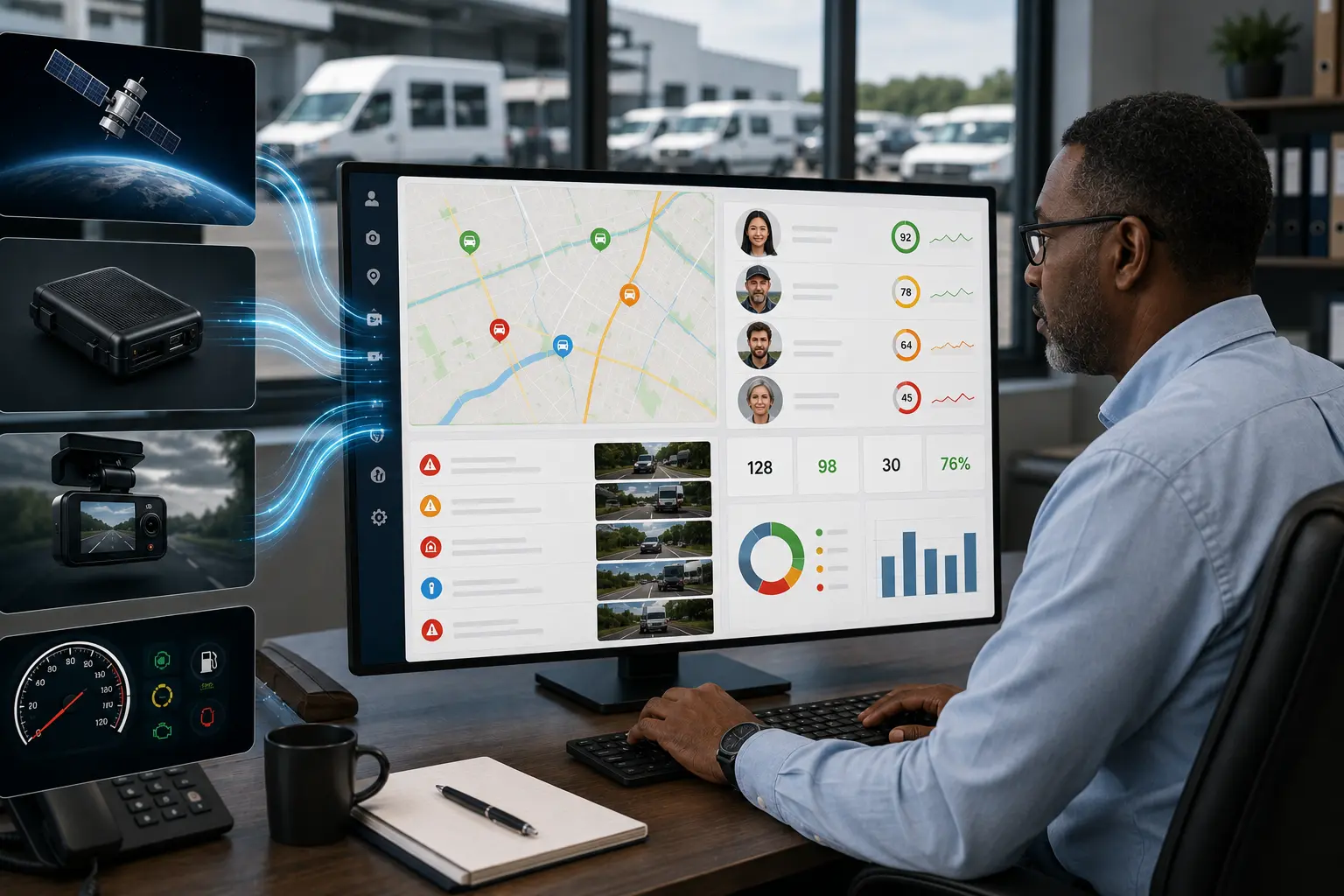
Fleet driver monitoring is the process of tracking how drivers operate fleet vehicles in real time using GPS, telematics, and dash camera data. For fleet managers, monitoring has shifted from a discretionary investment to a core operational requirement. Insurance loss ratios continue climbing, accident-related liability grows more expensive each year, and customer expectations around delivery accuracy keep raising the bar with time.
This guide walks through what fleet driver monitoring is, the three core technologies that power it (GPS, telematics, and dash cameras) and how to set up real-time monitoring without overwhelming managers or alienating drivers, the metrics that actually matters in fleet industry and how to convert monitoring data into measurable safety improvements. It also connects to the broader fleet safety and compliance framework that ties together driver, vehicle, and regulatory readiness.
Key Takeaways
- Fleet Driver Monitoring Tracks Real-Time Driver Behavior, Not Just Vehicle Location. It combines GPS, telematics, and dash camera data into a single operational picture that goes well beyond knowing where a vehicle is at any moment.
- Three Technologies Work Together Better Than Any One Alone. GPS handles location and route data, telematics captures driver behavior signals, and dash cameras provide visual context. Each fills gaps the others cannot.
- Real-Time Monitoring Enables Intervention Before Incidents Occur. Fleet managers can address risky behavior through coaching the same day it happens rather than weeks later after a crash investigation.
- The Metrics That Matter Are Specific and Actionable. Speeding events per 1,000 miles, hard braking frequency, idle time, and seatbelt compliance translate to real coaching conversations. Generic safety scores rarely do.
- Coaching Is Where Monitoring Earns Its ROI. Data without conversation creates resentment. Data paired with structured coaching changes behavior and reduces incidents over time.
- Integration With Fleet Software Multiplies Value. Connecting monitoring data with maintenance records, inspection logs, and incident reports creates one operational view rather than three disconnected dashboards.
What Is Fleet Driver Monitoring?
Fleet driver monitoring is the continuous tracking and analysis of driver behavior across a commercial vehicle fleet using a combination of GPS, telematics, and dash camera technologies. The goal is to convert raw operational data into actionable information that improves safety, reduces accident frequency, and lowers operational costs.
Most fleet driver monitoring systems collect four categories of data:
- Location data showing where vehicles are at any given moment, what route they followed, and whether they stayed within approved service areas.
- Behavioral data capturing how drivers operate vehicles, including speed, acceleration patterns, braking force, cornering aggressiveness, and idle time.
- Visual data from forward-facing and driver-facing cameras that show road conditions and in-cab behavior.
- Vehicle health data including engine diagnostics, fault codes, and maintenance indicators.
When these four data streams are consolidated into a single dashboard, fleet managers get a complete operational picture of the fleet rather than fragmented reports from disconnected tools. This consolidated view is what transforms monitoring from a surveillance exercise into a safety management discipline.
Why Fleet Driver Monitoring Matters
Fleet driver monitoring delivers measurable benefits across five operational areas. These benefits compound over time as data, coaching, and policy enforcement reinforce each other.
Reduced Accident Frequency
Fleets that implement structured driver monitoring with telematics-based coaching typically see at-fault accident rates drop 20 to 40 percent within the first 18 months. The reduction comes from intervening on risky behavior patterns before they escalate to incidents.
Lower Insurance Premiums
Insurance carriers increasingly underwrite commercial fleets based on documented safety practices and behavior data. Fleets with verified monitoring systems often qualify for lower premiums, broader coverage, and faster claim resolution when incidents do occur.
Reduced Fuel and Operating Costs
Driver behavior directly affects fuel consumption and vehicle wear. Aggressive acceleration, hard braking, and excessive idling all add operational cost. Monitoring identifies which drivers contribute most to these costs and where coaching can drive the biggest savings.
Improved Incident Documentation
When accidents do occur, integrated monitoring data combining GPS location, telematics events, and dash camera footage creates a defensible record that protects the fleet during insurance reviews, legal disputes, and regulatory audits.
Better Driver Retention Through Recognition
Monitoring data also identifies your best drivers. Fleets that use the data to recognize safe driving consistently see lower turnover among their top performers, since recognition is one of the strongest retention drivers for commercial drivers.
The Three Core Technologies of Fleet Driver Monitoring
Modern fleet driver monitoring is built on three foundational technologies. Each one solves a specific part of the visibility problem, and the combination delivers what no single technology can.
GPS Fleet Tracking
GPS tracking establishes the foundation of any monitoring system by answering the basic question of where vehicles are at any given moment. Modern GPS systems go well beyond simple location dots on a map.
A GPS tracking system typically provides:
- Real-time vehicle location and movement
- Historical route playback for any past trip
- Geofencing alerts when vehicles enter or leave defined areas
- Idle time tracking at job sites and stops
- Route efficiency analysis comparing planned versus actual paths
GPS data is also the connective tissue between the other monitoring layers. Telematics events become more useful when paired with the exact location where they occurred. Dash camera footage becomes more valuable when timestamps align with GPS coordinates.
Solutions like GPS fleet tracking and telematics give fleet managers this foundation in a single platform.
Telematics
Telematics extends monitoring from location to behavior. Where GPS answers "where," telematics answers "how."
Telematics systems capture:
- Speed and speeding violations relative to road limits
- Acceleration intensity, which is a behavioral and fuel-cost signal
- Braking force, which indicates either road conditions or driving habits
- Cornering force, which correlates with rollover risk
- Idle time when the engine runs without movement
- Seatbelt status, where supported by the vehicle
- Vehicle health diagnostics including engine fault codes and maintenance alerts
Telematics data is also the foundation for driver scorecards. By converting raw events into objective scores, telematics gives fleet managers a way to compare drivers fairly and identify both top performers and coaching priorities.
For fleets implementing telematics, structured driver behavior monitoring frameworks help managers turn raw event data into a repeatable coaching process.
Dash Cameras
Dash cameras add visual context that GPS and telematics alone cannot provide.
Forward-facing dash cameras record road conditions, traffic, and incidents. Dual-facing systems also record the driver cabin, which is critical for distracted driving prevention and fatigue detection. AI-enabled cameras add real-time event detection, flagging behaviors like phone use, drowsiness, lane departure, and following too closely.
Dash camera footage serves multiple operational purposes:
- Visual evidence in disputed accident claims
- Real-time coaching opportunities for live behavior events
- Training material derived from real incidents
- Protection for drivers against false claims and staged incidents
For a deeper look at the camera category specifically, fleet driver safety cameras compare the three main camera types and how to choose between them.
When all three technologies feed into a single platform, fleet managers stop switching between disconnected dashboards and start managing safety as one integrated discipline.
What Each Technology Tracks
The three technologies overlap in some areas and cover unique ground in others. The table below summarizes what each one tracks and where the overlaps and gaps are.
| Data Captured | GPS Tracking | Telematics | Dash Cameras |
|---|---|---|---|
| Vehicle location | Yes | Indirectly (paired GPS) | No |
| Route history | Yes | No | No |
| Speeding events | Indirect via location and speed limits | Direct measurement | Visual context only |
| Hard braking | No | Yes | Visual context |
| Acceleration patterns | No | Yes | No |
| Cornering force | No | Yes | No |
| Idle time | Yes | Yes | No |
| Distracted driving | No | No | Yes (driver-facing) |
| Fatigue indicators | No | No | Yes (AI-enabled) |
| Visual evidence of incidents | No | No | Yes |
| Engine diagnostics | No | Yes | No |
| Seatbelt compliance | No | Yes (some systems) | Yes |
The pattern is clear. No single technology delivers complete visibility. Fleets that adopt all three with proper integration see the strongest combined safety and efficiency improvements.
How to Set Up Real-Time Driver Behavior Monitoring
Setting up real-time monitoring across a fleet is a phased project, not a one-week installation. Most small-to-mid fleets stage the rollout across two to three months in five phases.
Phase 1: Define What You Are Measuring
Before installing any hardware, define the specific behaviors you want to monitor and what good performance looks like. Common starting metrics include speeding events per 1,000 miles, hard braking frequency, idle time per shift, and seatbelt compliance rate. Define acceptable thresholds for each.
Phase 2: Select Hardware and Platform
Choose telematics devices and dash cameras that integrate with each other and with the fleet management platform you use for maintenance and inspection records. Avoid stitching together standalone tools where possible. Integration is what turns monitoring data into actionable insight.
Phase 3: Install and Configure
Install devices across the fleet in waves rather than all at once. Configure thresholds and alert rules conservatively at first to avoid alert fatigue. You can tighten thresholds later as drivers and managers adjust to the system.
Phase 4: Communicate to Drivers
How you introduce monitoring to drivers shapes long-term adoption. Communicate the program transparently, emphasize protection against false claims, and frame the data as a coaching tool rather than surveillance. Drivers who understand the program tend to support it.
Phase 5: Build Review and Coaching Cadence
Real-time monitoring is only useful if someone acts on the data. Establish a weekly or biweekly review cadence where managers check the dashboard, identify drivers needing coaching, and schedule conversations. This cadence is where monitoring earns its return.
Fleets that follow this phased approach consistently see higher driver buy-in and stronger long-term outcomes than fleets that try to launch monitoring as a single big-bang deployment.
Key Metrics to Track in a Driver Monitoring System
The metrics fleet managers track determine whether monitoring becomes a useful safety discipline or just another dashboard nobody opens. The most effective fleets focus on a small set of specific, actionable metrics rather than tracking everything available.
The core metrics worth tracking include:
- Speeding events per 1,000 miles. Normalizes speeding behavior across drivers with different route lengths.
- Hard braking events per 1,000 miles. Indicates either following distance issues or aggressive driving.
- Acceleration events per 1,000 miles. A strong predictor of fuel cost and vehicle wear.
- Idle time per shift. Surfaces fuel waste and route inefficiency.
- Seatbelt compliance rate. A fundamental safety baseline and often a regulatory requirement.
- Driver scorecard ranking. Combines the above metrics into a single comparable score across the fleet.
- Coaching sessions completed per driver per quarter. Measures whether the program is actually being run.
Most modern platforms provide these metrics through built-in dashboards. Tools like fleet reports and dashboards consolidate behavior data with maintenance and inspection metrics, which lets managers spot patterns across vehicle, driver, and operational dimensions.
For a comprehensive look at the safety monitoring side specifically, this fleet safety monitoring guide covers the metrics, processes, and frameworks that turn data into measurable safety outcomes.
The trap most fleets fall into is tracking too many metrics at once. Start with three or four, build a coaching habit around them, then expand once the process is running smoothly.
Turning Monitoring Data Into Driver Coaching
Monitoring data has no operational value until it changes driver behavior. The mechanism for that change is structured coaching.
Effective driver coaching follows a consistent process:
- Identify the driver and the specific behavior pattern from the monitoring data
- Schedule a one-on-one conversation rather than addressing it over email
- Show the driver the data and any relevant dash camera footage
- Discuss what happened, what conditions contributed, and what a different approach would look like
- Document the conversation and set follow-up expectations
- Review the same metric in the next coaching session to confirm improvement
The tone of coaching matters more than the data itself. Drivers respond to coaching that feels supportive and specific. They resist coaching that feels punitive or vague.
Fleets that integrate coaching into a broader fleet driver safety program tend to see the most consistent long-term improvements, because policy, training, and monitoring all reinforce each other rather than running as isolated initiatives.
Recognition is the other side of coaching. Identifying and recognizing top drivers based on monitoring data reinforces the behavior you want across the rest of the fleet. Fleet safety best practices that combine coaching with recognition consistently outperform programs built on monitoring alone.
How Fleet Management Software Brings Monitoring Together
Most fleets running monitoring programs face the same operational problem. Monitoring data lives in one dashboard, maintenance records in another, inspection results in a third, and incident reports in email threads or shared drives. Each tool generates useful data, but the fragmentation makes it hard to see patterns across them.
Fleet management software brings the operational view back together by centralizing:
- Driver profiles and screening records
- Telematics behavior data
- Dash camera footage and event flags
- Vehicle inspection results
- Preventive maintenance schedules and service history
- Incident documentation and corrective actions
Tools that support fleet user and driver management connect monitoring data to specific drivers and their broader operational records. Maintenance integration through fleet preventive maintenance schedules connects driving behavior to its impact on vehicle health.
Fleets that build cameras and monitoring into a broader driver safety system see compounding gains over time. Data, coaching, and policy enforcement reinforce each other instead of running as separate workstreams that compete for manager attention.
The right software supports the human work of policy, training, and coaching. It removes the friction and documentation overhead that causes most monitoring programs to lose momentum after the first year.
Frequently Asked Questions
-
What is fleet driver monitoring?
Fleet driver monitoring is the continuous tracking and analysis of driver behavior across a commercial vehicle fleet using GPS, telematics, and dash camera technologies. It combines location data, behavior signals like speeding and hard braking, visual context from cameras, and vehicle health diagnostics into a single operational view. The goal is to reduce accidents, lower insurance and fuel costs, and improve driver performance through data and coaching. -
How do you monitor fleet driver behavior in real time?
Real-time fleet driver behavior monitoring requires telematics devices installed in each vehicle, optional dash cameras for visual context, and a software platform that consolidates the data. The system captures behaviors like speeding, hard braking, harsh cornering, and idle time as they happen, and surfaces them on a dashboard or through alerts. Managers review the data on a weekly or biweekly cadence and use it for coaching conversations with drivers. -
What is the difference between GPS, telematics, and dash cams for driver monitoring?
GPS tracking provides location and route data. Telematics captures how drivers operate vehicles, including speed, acceleration, braking force, and idle time. Dash cameras add visual context with forward-facing and driver-facing video. GPS answers where, telematics answers how, and dash cameras answer what happened. Each technology has gaps the others fill, which is why integrated systems combining all three deliver the strongest monitoring outcomes. -
What metrics should fleet managers track for driver behavior?
The core metrics worth tracking are speeding events per 1,000 miles, hard braking events per 1,000 miles, harsh acceleration events per 1,000 miles, idle time per shift, seatbelt compliance rate, and an overall driver scorecard score. Most fleets start with three or four of these metrics, build a consistent coaching habit, and expand later. Tracking too many metrics at once typically leads to a dashboard nobody actually uses. -
How do dash cams and telematics work together for fleet safety?
Dash cams and telematics work together by combining behavioral data with visual context. Telematics flags events like hard braking or harsh cornering with timestamps and severity scores. Dash cameras show what was happening visually at the same moment. Combined, fleet managers can distinguish between unavoidable hard braking caused by another driver and habitual hard braking caused by tailgating. The combination also creates stronger incident documentation, since visual evidence supports the telematics record during insurance and legal reviews.