 Miya Bholat
Mar 26, 2026
How to Prioritize Fleet Work Orders to Reduce Downtime
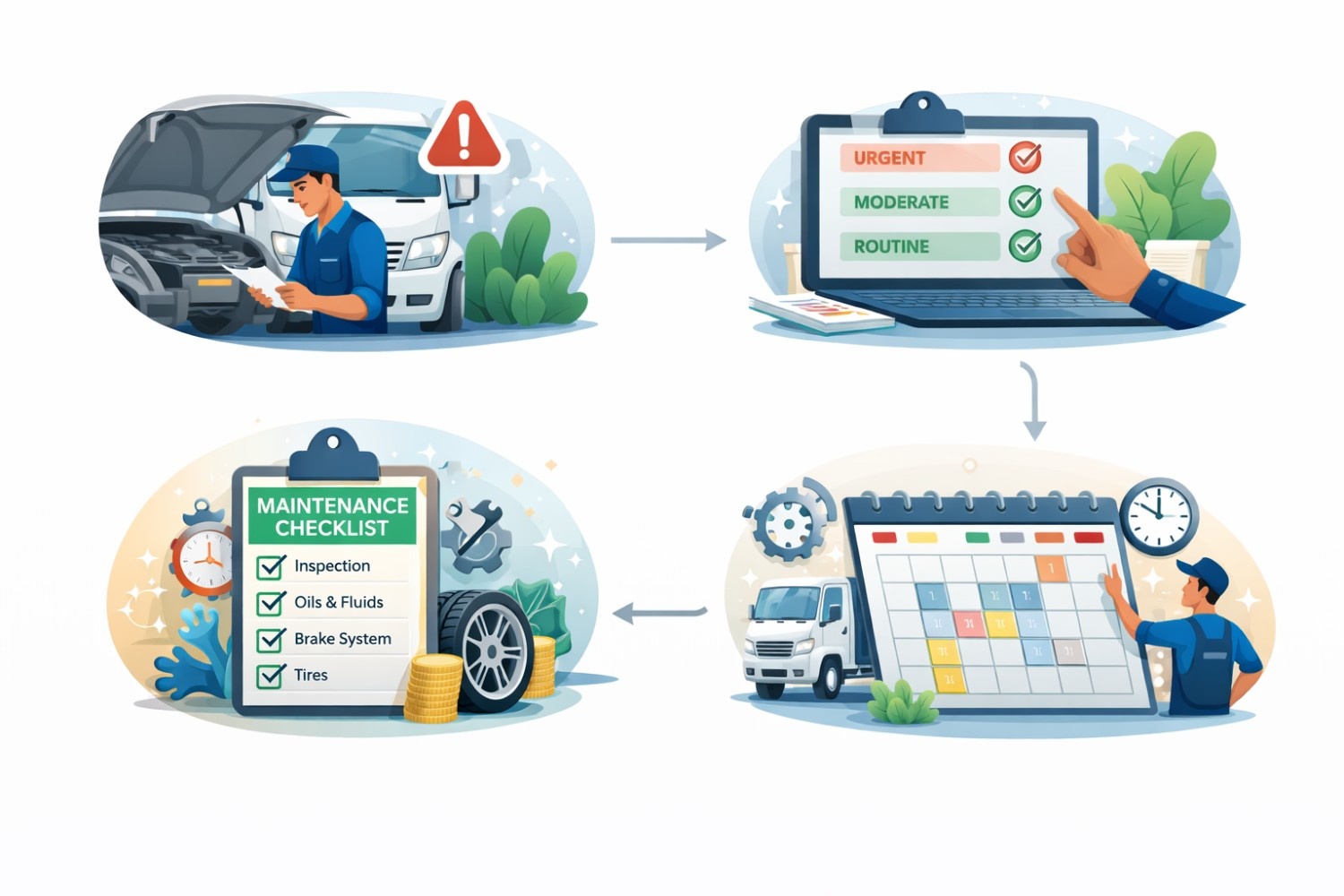
Key Takeaways: Building a Prioritization System That Sticks
- Not all work orders are equal
Treating every repair the same leads to wasted time, higher costs, and unnecessary downtime. - Safety and compliance must always come first
These are non-negotiable priorities that should bypass any standard queue. - Focus on high-impact vehicles
Prioritize assets that drive the most revenue or operational value to minimize disruption. - Use a scoring system to remove guesswork
A simple ranking model ensures consistent, objective decisions across your team. - Team coordination is just as important as the system itself
Clear communication and shared visibility prevent high-priority jobs from slipping through. - Leverage software to scale and automate prioritization
Digital tools ensure consistency, improve visibility, and keep your fleet running efficiently.
Why Work Order Prioritization Directly Impacts Fleet Uptime
Every fleet manager has felt it — a vehicle sits in the yard waiting for repair while another, less critical job gets completed first. That single decision can ripple across operations: missed deliveries, driver delays, and frustrated customers.
Work order prioritization isn't just a maintenance decision — it's an operational control lever.
Unplanned downtime is expensive. Depending on the industry, a single vehicle can cost anywhere from $400 to $1,000 per day when it's out of service. Multiply that across multiple vehicles, and poor prioritization quickly turns into a serious financial drain.
The real issue isn't a lack of maintenance effort — it's misaligned priorities.
When the wrong vehicle gets fixed first, you're not just delaying repairs. You're:
- Reducing fleet availability
- Increasing schedule disruptions
- Creating bottlenecks in operations
- Driving up total cost per mile
A well-prioritized work order system ensures that the most critical vehicles are always back on the road first — and that's what keeps uptime high.
The Hidden Cost of Treating All Work Orders Equally
Many fleets still operate on a simple rule: first-in, first-out. On paper, it feels fair. In reality, it's inefficient.
Not all work orders carry the same urgency — and treating them as equal creates avoidable problems.
Here's what typically happens when prioritization is missing:
- A low-impact repair gets completed while a high-revenue vehicle waits
- Minor cosmetic fixes consume technician time during peak demand
- Safety issues get delayed behind routine maintenance
- Parts availability delays high-priority jobs unnecessarily
This "flat priority" approach creates a domino effect.
For example, imagine a delivery van that handles 10 routes per day needing brake repair. If that work order gets delayed behind a non-critical repair on a backup vehicle, you're losing revenue every hour that van sits idle.
Over time, this leads to:
- Increased downtime across the fleet
- Higher emergency repair costs
- More reactive maintenance behavior
- Lower technician productivity
The goal isn't to work faster — it's to work smarter.
A Practical Framework for Ranking Fleet Work Orders
To prioritize effectively, you need a system that removes guesswork and focuses on impact. The best fleets don't rely on intuition — they follow a structured framework.
Safety-Critical Issues Come First — Always
Some repairs should never wait.
Anything that directly impacts driver safety or roadworthiness must jump to the top of the queue immediately.
These typically include:
- Brake system failures
- Steering or suspension issues
- Tire damage or blowout risks
- Lighting and visibility problems
If a vehicle isn't safe to operate, it shouldn't be on the road — and that work order becomes top priority, no exceptions.
High-Utilization Vehicles Deserve Priority Treatment
Not all vehicles contribute equally to your operation.
A vehicle running 10–15 jobs per day is far more critical than one used occasionally. Prioritizing based on utilization ensures you're protecting the assets that generate the most value.
A simple way to think about it:
- Priority = Usage Rate × Operational Impact
For example:
- Truck A: 12 routes/day → High priority
- Truck B: 2 routes/week → Lower priority
If both need repairs, Truck A should almost always come first.
This approach ensures that downtime hits your least critical assets — not your core revenue drivers.
Regulatory and Compliance Deadlines Are Non-Negotiable
Compliance-related work orders carry a different kind of risk — legal and financial.
Missing a required inspection or compliance deadline doesn't just affect operations. It can lead to fines, violations, or even vehicles being taken out of service.
Common examples include:
- DOT inspections
- Emissions testing
- Preventive maintenance intervals tied to regulations
These should be treated as fixed deadlines, not flexible tasks.
Delaying them introduces risk that goes far beyond downtime.
Repair vs. Defer: When It's Okay to Schedule Later
Not every issue needs immediate attention.
Some repairs can safely be deferred without impacting safety or operations. The key is knowing which ones.
Examples of deferrable work:
- Minor cosmetic damage
- Non-critical interior issues
- Low-impact wear items
Before deferring, ask:
- Does this affect safety?
- Will this worsen quickly if ignored?
- Does it impact vehicle availability?
If the answer is no across the board, it can likely be scheduled later — freeing up time for higher-priority work.
How to Score and Rank Work Orders Consistently
A framework is helpful — but scoring makes it actionable.
By assigning a simple score to each work order, you remove subjectivity and create consistency across your team.
A practical scoring model might include:
- Safety Risk (1–5): How dangerous is the issue?
- Vehicle Criticality (1–5): How important is this vehicle to operations?
- Compliance Urgency (1–5): Is there a deadline involved?
- Repair Time (1–5): How long will this job take?
- Parts Availability (1–5): Are parts ready or delayed?
You can combine these into a total score.
For example:
- Brake repair on high-use truck → Score: 22/25 → Top priority
- Cosmetic dent on backup vehicle → Score: 6/25 → Low priority
This system ensures:
- Everyone evaluates work orders the same way
- Decisions are data-driven, not reactive
- High-impact jobs consistently rise to the top
Fleets using structured scoring often see immediate improvements in uptime and technician efficiency.
Coordinating Prioritization Across Your Maintenance Team
Even the best prioritization system fails without team alignment.
If technicians don't understand priorities — or if communication breaks down — high-priority jobs can still get buried.
To avoid this, prioritization needs to be visible and shared.
Here's how to make it work operationally:
- Start each day with a quick prioritization review
- Clearly mark high-priority work orders
- Assign jobs based on skill and urgency
- Track progress throughout the day
- Re-evaluate priorities as new issues come in
A simple daily workflow can make a huge difference.
For example:
- Morning: Review top 5 priority jobs
- Midday: Check progress and adjust if needed
- End of day: Plan next day's priorities
The goal is to ensure that everyone — from managers to technicians — is working from the same playbook.
Without coordination, even a perfect system breaks down.
Using Fleet Maintenance Software to Automate Work Order Priority
Manual prioritization works — but it doesn't scale well.
As fleets grow, keeping track of priorities across dozens (or hundreds) of vehicles becomes increasingly complex. This is where software makes a measurable difference.
With a system like fleet maintenance software, prioritization becomes automated and visible.
Modern tools help by:
- Assigning priority levels to work orders
- Triggering alerts for overdue maintenance
- Tracking vehicle status in real time
- Managing technician assignments
- Centralizing all maintenance data
For example, using a fleet maintenance work order system allows teams to:
- Flag safety-critical repairs instantly
- Ensure preventive maintenance tasks aren't missed
- Keep high-utilization vehicles at the top of the queue
You can also connect prioritization with preventive maintenance strategies. A well-structured preventive maintenance schedule ensures that high-risk issues are addressed before they become urgent work orders.
The real advantage isn't just automation — it's consistency.
Software ensures that:
- No critical job gets overlooked
- Priorities are visible to the entire team
- Decisions are based on real data, not guesswork