 Miya Bholat
Jul 31, 2026
What Is Fleet Rightsizing in Fleet Management?

Fleet rightsizing means aligning the number, type, size, and location of vehicles with the work your organization actually performs. It is a continuous fleet cost management process that uses utilization, maintenance, operational, and financial data to determine whether vehicles should be retained, reassigned, replaced, shared, or removed.
Rightsizing does not automatically mean reducing the fleet. A fleet may need fewer vehicles at one location, more vehicles at another, or a different vehicle class for a particular duty cycle. The objective is to maintain enough capacity to complete the work without paying for assets that add little operational value.
Key Takeaways
- Rightsizing is not the same as downsizing. Downsizing focuses on reducing vehicle count, while rightsizing matches fleet capacity and composition to actual demand.
- Underused vehicles still create substantial costs. Insurance, depreciation, registration, storage, maintenance, and administration continue even when a vehicle rarely moves.
- Maintenance records can reveal misalignment early. Rising repair frequency, parts consumption, and maintenance cost per mile can expose poor asset allocation before utilization reports make the problem obvious.
- Vehicle type matters as much as vehicle count. Replacing an oversized truck with a van may improve fleet efficiency without reducing operational capacity.
- Rightsizing should be reviewed regularly. Routes, contracts, staffing, seasonal demand, and service areas change, so a fleet that fits today may become misaligned later.
What Fleet Rightsizing Really Means (and What It Doesn't)
Fleet rightsizing is the process of matching vehicle inventory to operational requirements using measurable evidence. It examines how many vehicles are needed, which classes are appropriate, where they should be located, and how they should be assigned.
Consider a fleet with 40 vehicles where 12 units remain parked during 70 percent of normal operating hours. The problem is not simply that the fleet is too large. Some departments may have excess capacity while another department is renting vehicles or delaying work. The fleet is misaligned.
A rightsizing review may result in several different actions:
- Reassign an underused vehicle to a busier location.
- Pool vehicles that do not require permanent assignment.
- Replace a large vehicle with a smaller class.
- Remove an asset with no continuing mission requirement.
- Add capacity where demand consistently exceeds availability.
- Replace an unreliable vehicle that causes repeated disruption.
Federal fleet guidance defines rightsizing as matching vehicle requirements to the organizational mission. Its Vehicle Allocation Methodology evaluates utilization, trips, mileage, downtime, mission, vehicle condition, passenger needs, and cargo requirements rather than relying only on total fleet count.
Rightsizing vs. Downsizing: Why the Distinction Matters
Downsizing begins with a cost reduction target and asks how many vehicles can be removed. Rightsizing begins with operational demand and asks what combination of assets can support that demand at the lowest sustainable cost.
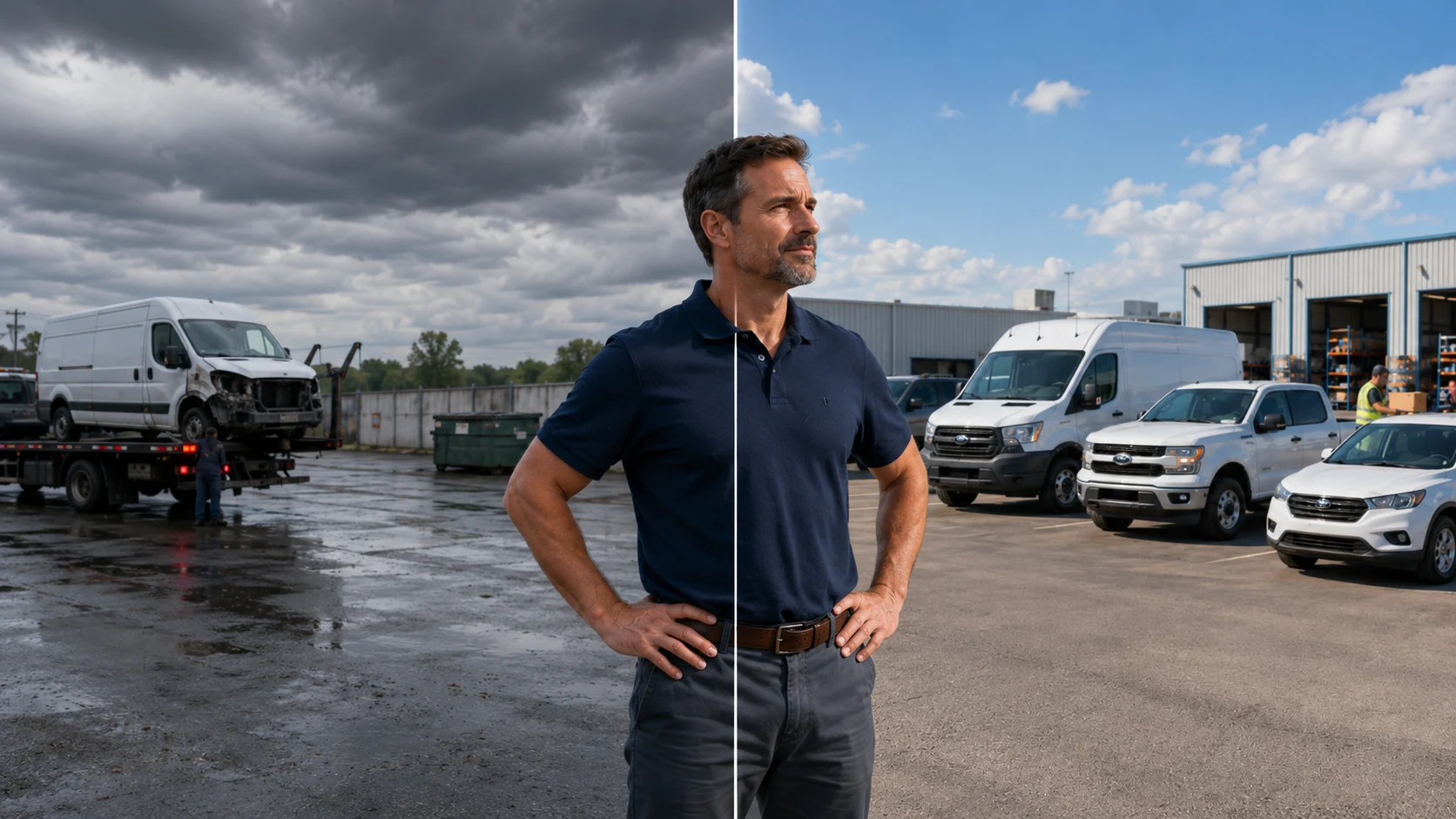
When fleets remove vehicles without studying demand, they may create new expenses. Departments can end up renting vehicles during busy periods, paying employees to wait for shared units, overloading the remaining assets, or extending replacement cycles beyond economical limits.
A proper decision therefore considers capacity and consequences together.
| Decision | Primary Question | Common Result |
|---|---|---|
| Downsizing | How many vehicles can we remove? | Lower vehicle count |
| Rightsizing | What assets does the operation require? | Better fleet alignment |
| Replacement | Is this vehicle still economical and reliable? | Newer or different asset |
| Reassignment | Is capacity available in the wrong location? | Higher asset utilization |
| Pooling | Does this vehicle require permanent assignment? | Shared access across teams |
A fleet might remove three sedans, add one cargo van, and replace two full size trucks with smaller pickups. The total vehicle count falls, but the more important result is that each vehicle better matches its work.
The Hidden Cost of an Oversized Fleet
An underused vehicle does not become free when it sits in a parking lot. Many ownership costs continue regardless of mileage.
The annual carrying cost may include:
- Insurance premiums.
- Registration, licensing, and inspections.
- Depreciation and financing costs.
- Parking, storage, and facility space.
- Scheduled maintenance based on time.
- Battery, tire, and fluid deterioration.
- Administrative and recordkeeping labor.
- Telematics, toll, and subscription charges.
Insurance alone may cost roughly $1,200 to $3,000 annually depending on the vehicle, location, use, and coverage. Once depreciation, registration, storage, maintenance, and administration are included, an idle or lightly used unit can reasonably consume $5,000 to $7,000 per year.
Fleet managers should calculate these costs from their own records rather than apply one universal benchmark. A vehicle total cost of ownership analysis provides a stronger basis for rightsizing than mileage alone because it captures both fixed and variable costs.
Oklahoma provides a useful public sector fleet rightsizing example. Its annual evaluation found that 7,955 vehicles, nearly 75 percent of the state fleet, traveled fewer than 12,000 miles per year. Agencies turned in 655 underutilized vehicles, producing projected savings of $5.9 million.
That equals approximately $9,000 in projected savings per vehicle, although the exact benefit would vary by age, condition, resale value, and operating cost.
Signs Your Fleet Needs Rightsizing
Fleet misalignment usually appears through a combination of utilization, cost, maintenance, and assignment signals. One low mileage reading is not enough to justify removing a vehicle, but several recurring signals warrant investigation.
Utilization Signals That Point to Misalignment
Potential warning signs include:
- Vehicles remain below 60 percent utilization for several months.
- Units remain parked during normal business hours.
- Some locations rent vehicles while others hold unused capacity.
- Departments request new assets despite low use elsewhere.
- Similar vehicles show sharply different trip or mileage totals.
- Seasonal equipment remains assigned throughout the full year.
The correct utilization threshold depends on mission requirements. Emergency, utility, fire, public safety, and backup vehicles may need to remain available even when normal usage is low. A government fleet management operation should therefore separate mission essential reserve capacity from ordinary underutilization.
Telematics can support that distinction by measuring miles, engine hours, trips, days used, and location patterns. Federal telematics guidance recommends these metrics for identifying vehicles that may be reassigned, pooled, replaced, or removed.
Maintenance Trends That Reveal the Problem First
Maintenance data often exposes rightsizing problems before an annual utilization review.
An older unit may still record acceptable mileage while requiring increasingly frequent repairs. Another vehicle may have low use but continue generating battery failures, tire deterioration, inspections, recalls, and time based service work. At the same time, heavily used vehicles elsewhere may accumulate work orders faster than the shop can complete them.
Review these indicators by vehicle:
| Maintenance Indicator | What It May Reveal | Potential Decision |
|---|---|---|
| Rising cost per mile | Vehicle is becoming uneconomical | Replace or reassign |
| Repeated unscheduled repairs | Reliability no longer supports the duty | Replace |
| Low use with recurring service cost | Asset creates cost without enough output | Pool or remove |
| High use with growing downtime | Capacity may be insufficient | Add or redistribute capacity |
| Excess parts consumption | Vehicle class or age mix may be inefficient | Standardize or replace |
| Growing work order backlog | Remaining assets may be overloaded | Rebalance fleet capacity |
A complete vehicle service history helps managers compare repair patterns over time. Reviewing rising fleet maintenance costs alongside utilization makes it easier to distinguish an unnecessary vehicle from a heavily used vehicle that requires replacement.
The "Ghost Assignment" Problem
A ghost assignment occurs when a vehicle appears assigned and necessary in fleet records but remains unused because a department or individual informally controls it.
These vehicles can escape review because the assignment field creates the appearance of demand. The department may also resist reassignment because it views the vehicle as guaranteed capacity for possible future needs.
Resolving ghost assignments requires more than a spreadsheet. Fleet managers need trip records, days used, work purpose, seasonal requirements, and documented exceptions. Leadership must also establish that vehicles belong to the organization, not to individual departments.
How to Rightsize Your Fleet Using Data
A reliable rightsizing process combines operational need, utilization, maintenance, and ownership cost instead of making decisions from one report.
Start With a Fleet Utilization Audit
Use at least 12 months of data so seasonal changes do not create false conclusions. A snow vehicle, school transportation unit, construction asset, or emergency support vehicle may appear unnecessary during part of the year but become essential during peak periods.
For every vehicle, measure:
- Miles or engine hours.
- Number of trips.
- Days used and days parked.
- Idle time.
- Peak and seasonal demand.
- Passenger or cargo requirements.
- Department and location assignment.
- Mission criticality.
The Department of Energy recommends establishing a baseline fleet profile before comparing the existing fleet with mission needs. Its methodology also calls for annual review of utilization, downtime, age, maintenance, vehicle condition, trips, passenger needs, and cargo capacity.
Data from GPS tracking and telematics can show whether an asset is genuinely active, occasionally used, or simply moved often enough to appear utilized.
Layer in Maintenance Cost Analysis
Next, compare utilization with maintenance cost, repair frequency, downtime, and parts consumption.
Use this decision workflow:
A low use vehicle with rising repair costs is a strong removal candidate. A high use vehicle with increasing repairs may require replacement rather than elimination. A low use but mission essential vehicle may need to be retained with its exception clearly documented.
A fleet maintenance work order system can provide labor, parts, repair frequency, and downtime records for this comparison. AUTOsist can centralize those records with utilization and cost reporting so managers can support recommendations with documented evidence rather than assumptions.
Match Vehicle Class to Actual Duty Cycle
Rightsizing also means correcting vehicle type.
Over time, fleets often assign available vehicles instead of appropriate vehicles. A full size pickup may perform work that a cargo van could handle. A sedan may be used for terrain that requires an SUV. A specialized truck may spend most of its time completing ordinary transport tasks.
Ask four questions before retaining or replacing each vehicle:
- What work does the vehicle perform most often?
- What payload, towing, passenger, and terrain capacity does that work require?
- Is a smaller or more efficient class suitable?
- Could one standardized class serve several departments?
Reducing unnecessary class variation can simplify technician training, parts stocking, inspections, and preventive maintenance. This is particularly useful in a construction fleet operation where vehicle assignments can change by project, crew, and job site.
Why Fleet Rightsizing Fails: and How to Avoid It
Even strong data will not produce results unless the organization addresses ownership behavior, implementation pace, and continuing review.
Internal Resistance and Department Politics
Departments may view assigned vehicles as entitlements. Managers may fear that surrendering one vehicle will prevent them from getting capacity later. Drivers may oppose vehicle sharing because permanent assignments feel more convenient.

Fleet leaders can reduce resistance by publishing consistent decision criteria. Show the utilization period, maintenance cost, mission requirement, replacement need, and proposed alternative for every affected asset.
Transparent fleet reports and dashboards move the discussion away from personal opinion and toward documented operational evidence.
Going Too Big Too Fast
A large one time reduction can disrupt service and create lasting resistance. A safer approach is to connect rightsizing with the annual replacement process.
Before replacing any vehicle, ask whether the organization still needs:
- A dedicated vehicle for that assignment.
- The same vehicle class.
- Capacity at the same location.
- A new vehicle rather than a reassigned unit.
Pilot pooling or reassignment with a small group, measure response times and availability, then expand only after confirming that service levels remain stable.
Treating Rightsizing as a One Time Project
Fleet demand changes as contracts begin or end, routes shift, staffing changes, facilities open, and service areas expand. A fleet can return to excess capacity when departments acquire vehicles without reviewing existing inventory.
Quarterly monitoring with a rolling 12 month review provides a practical balance. Managers can flag unusual changes during the quarter while reserving major disposal and acquisition decisions for a complete annual analysis.
How Fleet Management Software Supports Rightsizing
Fleet management software supports rightsizing by connecting utilization, maintenance, work order, cost, and assignment data at the vehicle level.
The most useful capabilities include:
- Automated mileage and trip tracking.
- Maintenance cost per vehicle reporting.
- Repair frequency and downtime analysis.
- Work order and parts cost histories.
- Vehicle assignment records.
- Fleet dashboards for comparing locations and departments.
- Documentation for budget and disposal approvals.
The software does not make the final decision. It gives fleet managers a consistent evidence base for identifying which assets support the mission and which assets create cost without sufficient value.
Frequently Asked Questions
-
How often should you review fleet size?
Review utilization and maintenance indicators quarterly and complete a detailed rightsizing analysis at least once each year. A new review is also appropriate when contracts, routes, staffing, locations, or service requirements change substantially. -
What utilization rate means a vehicle should be removed?
There is no universal removal threshold. Utilization below 60 percent may justify investigation, but mission criticality, seasonal demand, backup requirements, cost, vehicle condition, and access to shared capacity must also be considered. -
Can rightsizing apply to fleets with fewer than 25 vehicles?
Yes. A small fleet may feel the cost of one unnecessary or mismatched vehicle more sharply because that asset represents a larger percentage of total fleet spending. Small fleets can begin with mileage, days used, maintenance cost, and assignment data. -
What is the difference between fleet rightsizing and fleet optimization?
Rightsizing focuses on matching fleet size, composition, and location to demand. Fleet optimization is broader and may include routing, fuel efficiency, maintenance scheduling, driver performance, procurement, safety, and asset lifecycle decisions. -
How do you rightsize without disrupting daily operations?
Begin with low risk actions such as reassigning underused vehicles, creating a small shared pool, or reviewing vehicles already scheduled for replacement. Measure availability, service delays, rentals, overtime, and employee feedback before expanding the change.