 Miya Bholat
Mar 02, 2026
Electric Vehicle Fleet Management Guide: Costs, Charging, Maintenance & Software Strategy
Key Takeaways for Fleet Managers Considering the EV Switch
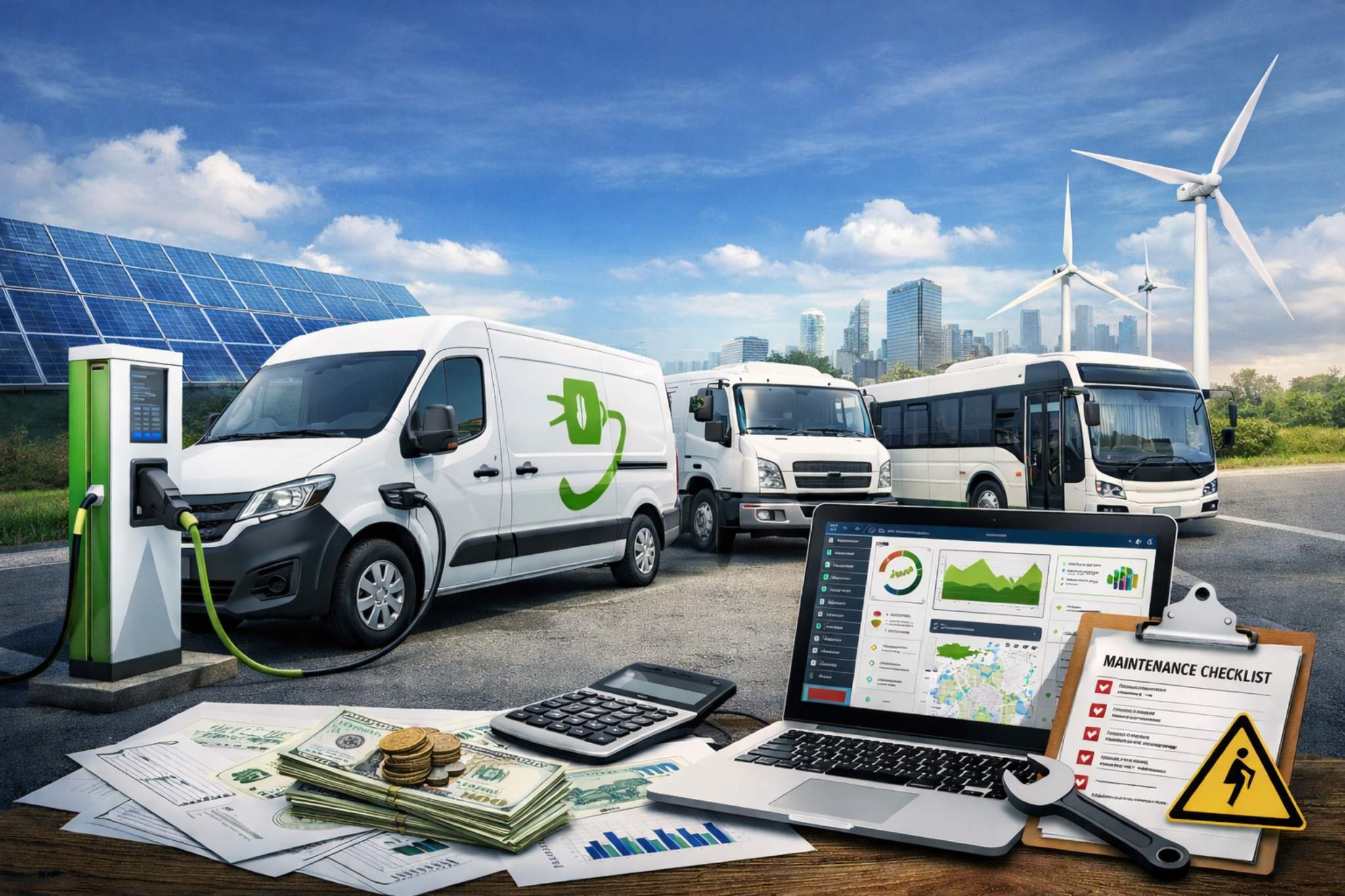
- EVs reduce operating costs over time. Energy and maintenance savings often outweigh higher upfront costs within several years.
- Charging strategy determines success. Depot charging with load management keeps energy costs predictable.
- Range planning must be data-driven. Route analytics and telematics reduce risk and improve utilization.
- Maintenance shifts, it doesn’t disappear. Battery health, software updates, and technician training become priorities.
- Fleet software must evolve. Tracking state of charge and energy costs requires modern fleet management platforms.
- Incentives significantly impact ROI. Federal, state, and utility programs can narrow acquisition cost gaps.
- Electrification is operational strategy, not just sustainability. The fleets that treat EV adoption as a systems-level transition — not just a vehicle purchase — see the strongest results.
Why Fleet Managers Are Switching to Electric Vehicles
Fleet electrification is no longer a pilot program conversation. It’s a budget line item.
Major delivery companies, utilities, municipalities, and service fleets are accelerating EV adoption because the math increasingly makes sense. According to the U.S. Department of Energy, electricity costs the equivalent of about $1.20 per gallon of gasoline when comparing energy content. For fleets running tens of thousands of miles per vehicle each year, that gap compounds quickly.
Fleet managers are also responding to:
- Rising fuel volatility
- Emissions mandates in cities and states
- Corporate sustainability targets
- Lower long-term maintenance costs
The conversation has shifted from “Should we test EVs?” to “How do we scale EVs without disrupting operations?”
That’s what this guide covers.
Total Cost of Ownership — EV vs. ICE Fleet Vehicles
When fleets compare electric vehicles (EVs) to internal combustion engine (ICE) vehicles, upfront price alone doesn’t tell the full story. Total cost of ownership (TCO) changes dramatically over a 5–8 year lifecycle.
Upfront Costs and Incentives
EVs typically carry higher purchase prices than comparable gas or diesel vehicles. A light-duty electric cargo van may cost $8,000–$15,000 more than its ICE counterpart.
However, incentives narrow the gap:
- Federal commercial clean vehicle tax credits (up to $7,500 per qualifying vehicle under the Inflation Reduction Act)
- State rebates that range from $2,000–$10,000 depending on location
- Utility company incentives for charging infrastructure
- Accelerated depreciation advantages for commercial fleets
When combined, these programs can offset a significant portion of the acquisition premium.
For fleets purchasing 20+ vehicles at once, bulk procurement negotiations often reduce pricing further.
Fuel and Energy Cost Savings
Fuel is where EVs shine.
Let’s compare a practical scenario:
- Average fleet vehicle mileage: 20,000 miles/year
- Gas vehicle fuel economy: 20 MPG
- Gas price: $3.50 per gallon
Annual fuel cost for ICE vehicle:
20,000 miles ÷ 20 MPG = 1,000 gallons
1,000 × $3.50 = $3,500 per year
Now compare to an EV:
- Average energy consumption: 0.35 kWh per mile
- Electricity cost: $0.13 per kWh
20,000 miles × 0.35 kWh = 7,000 kWh
7,000 × $0.13 = $910 per year
That’s roughly $2,590 in annual savings per vehicle on energy alone.
Multiply that across a 50-vehicle fleet and you’re looking at over $129,000 per year in potential fuel savings.
Maintenance Cost Differences
EVs have far fewer moving parts. No oil, no spark plugs, no fuel system, no exhaust system, and no transmission in the traditional sense.
Maintenance reductions typically include:
- No oil changes
- No transmission fluid service
- Reduced brake wear due to regenerative braking
- Fewer engine-related breakdowns
Studies from large fleet operators estimate maintenance savings between 20–40% compared to ICE vehicles over the vehicle lifecycle.
That doesn’t eliminate maintenance entirely — but it changes where your focus goes.
For deeper insight into tracking fleet maintenance costs effectively, see this fleet vehicle maintenance guide.
Charging Infrastructure — Planning for Your Fleet
Electrification fails without a charging strategy. Infrastructure planning must happen before vehicle deployment.
Depot Charging vs. Public Charging Networks
Most commercial fleets rely primarily on depot charging. Vehicles return to base, plug in overnight, and leave fully charged in the morning.
Depot charging advantages:
- Lower energy cost
- Predictable availability
- Simplified logistics
- Reduced driver dependency on public networks
Public charging plays a supplemental role for:
- Long-haul or regional fleets
- Emergency top-ups
- Multi-shift operations
For predictable daily routes, depot charging typically delivers the lowest total energy cost.
Level 2 vs. DC Fast Charging
Understanding charging speeds is critical.
- Level 2 charging: 240V, typically adds 20–30 miles of range per hour
- DC fast charging: Adds 60–200+ miles in 30 minutes
Level 2 chargers cost significantly less to install and are ideal for overnight depot charging. DC fast chargers cost more and require electrical upgrades but support high-utilization fleets.
Installation costs vary widely:
- Level 2: $2,000–$6,000 per port (including installation)
- DC Fast: $30,000–$100,000+ depending on capacity and site upgrades
Fleet utilization patterns should drive the decision — not charger speed alone.
Managing Charging Schedules to Control Energy Costs
Electricity pricing often fluctuates by time of day.
Smart fleets use:
- Time-of-use (TOU) rate optimization
- Overnight charging windows
- Load balancing across multiple vehicles
- Staggered charging start times
Without load management, fleets risk demand charges that spike electricity bills.
Range Management and Route Planning for EV Fleets
Range anxiety is real — but manageable with proper data.
Most modern commercial EVs provide 150–250 miles per charge. That works well for:
- Urban delivery fleets
- Municipal vehicles
- Service technicians
- School transportation
The key is pairing EV deployment with route analytics.
Fleet managers should monitor:
- Daily average route mileage
- Idle time and energy drain
- Climate impacts (cold weather reduces range)
- Payload impact on energy consumption
Integrated telematics makes this manageable. Systems like GPS fleet tracking and telematics allow managers to monitor location, usage patterns, and route efficiency in real time.
Optimized routing reduces unnecessary mileage and ensures vehicles return to base with adequate charge buffers.
EV Fleet Maintenance — What Changes and What Doesn't
Maintenance doesn’t disappear — it evolves.
Maintenance Tasks That Disappear
Fleet managers can remove several recurring services from the calendar:
- Engine oil and filter changes
- Transmission servicing
- Exhaust system repairs
- Fuel injector cleaning
- Spark plug replacement
This simplifies preventive maintenance scheduling considerably.
New Maintenance Priorities
EVs introduce new monitoring requirements:
- Battery health and degradation tracking
- Thermal management system inspections
- Software and firmware updates
- Tire wear (EVs are heavier and produce instant torque)
- Brake system inspection despite regenerative assistance
Battery performance becomes a key lifecycle metric. Monitoring state of health (SOH) helps determine long-term asset planning.
If you're building structured maintenance processes, this preventative maintenance guide for fleet operations provides a useful framework.
Training Your Technicians
High-voltage systems require new safety protocols.
Fleet shops transitioning to EVs must:
- Certify technicians for high-voltage systems
- Invest in insulated tools
- Implement battery isolation procedures
- Follow manufacturer repair guidelines strictly
Safety training is not optional — it’s operational risk management.
Fleet Management Software and EV Integration
Electrification exposes limitations in outdated fleet systems.
Traditional tracking focused on mileage and fuel usage. EV fleets require monitoring:
- State of charge (SOC)
- Charging session history
- Energy cost per mile
- Battery health trends
- Service scheduling tied to usage cycles
Fleet management platforms must adapt.
AUTOsist supports EV operations through:
- Preventive maintenance scheduling aligned with OEM guidance
- Integrated telematics data feeds
- Custom service intervals
- Digital inspections and documentation
- Real-time reporting dashboards
Learn more about how integrated platforms improve visibility in this guide on how integrated fleet management software connects your entire operation.
As fleets grow more complex, centralized data becomes the control center — not a spreadsheet.
Compliance, Reporting, and Sustainability Goals
EV adoption supports compliance and ESG initiatives, but documentation still matters.
Fleet managers must track:
- Emissions reductions
- Fuel displacement metrics
- Charging energy consumption
- Government reporting requirements
- Local zero-emission mandates
For public sector and regulated fleets, structured documentation supports audit readiness. A strong foundation in compliance tracking remains essential — whether the fleet runs diesel or electric. The fleet compliance guide provides additional clarity.
EVs reduce tailpipe emissions, but operational reporting still determines whether organizations meet sustainability benchmarks.
Electric vehicle fleet management isn’t about replacing engines. It’s about redesigning cost structure, infrastructure, maintenance processes, and data systems around a new propulsion model.
Fleets that plan holistically position themselves for long-term efficiency gains and regulatory resilience.