 Miya Bholat
Oct 27, 2026
Fleet Safety Reporting Cadence: What to Review When?
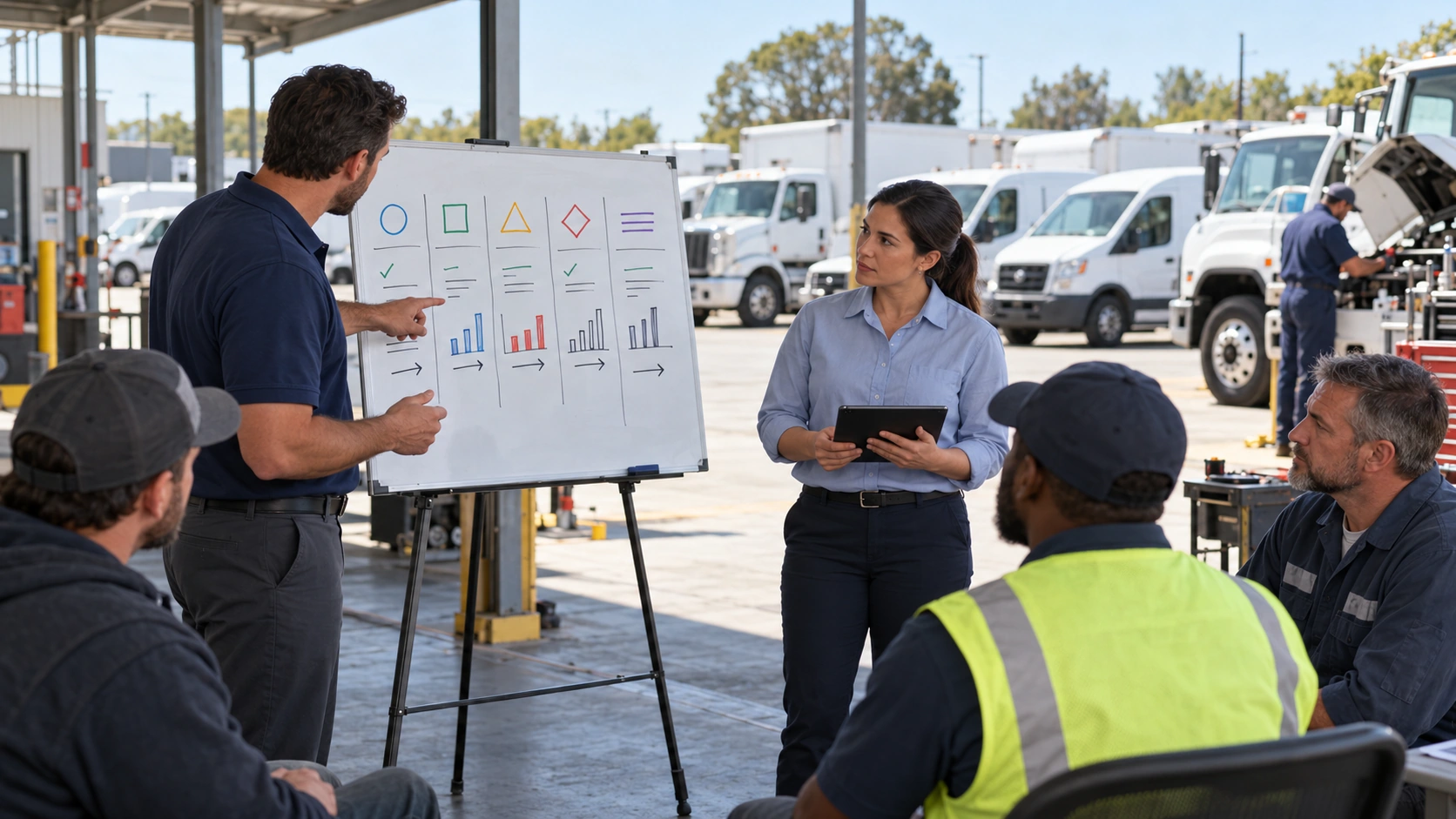
A fleet safety reporting cadence should review urgent vehicle and driver risks daily, recurring issues weekly, safety trends monthly, structural weaknesses quarterly, and overall program effectiveness annually. Each review needs a clear owner and escalation process so your fleet safety and compliance program catches immediate hazards while addressing the patterns that create future incidents.
Key Takeaways
- Daily reviews protect immediate safety. Supervisors identify critical defects, dangerous driving events, and vehicles that must remain out of service.
- Weekly reviews identify repeated risks. Safety managers examine recurring incidents, unresolved repairs, and drivers who need coaching.
- Monthly reviews measure safety performance. Fleet managers assess safety scores, inspection compliance, maintenance trends, and potential insurance exposure.
- Quarterly reviews reveal structural problems. Leadership evaluates policies, training effectiveness, recurring violations, and systemic risks.
- Annual reviews prove program effectiveness. Management documents corrective actions, evaluates yearly outcomes, and prepares evidence for audits and insurance renewals.
- Escalation connects every tier. Urgent hazards receive immediate attention, while recurring issues move into broader reviews until someone addresses their underlying causes.
Why Safety Reporting Cadence Beats a Single Big Report
A failed brake inspection needs attention today. Three drivers showing similar risky behavior across different routes may need a weekly coaching response. Rising safety violations across an entire department could require a quarterly policy change.
These problems develop at different speeds. Reviewing everything monthly means some risks remain unresolved for weeks, while reviewing every metric daily creates unnecessary noise.
Understanding what fleet managers should track weekly or monthly explains general reporting frequencies. Safety reporting needs two additional controls: escalation rules and named review owners.
Think of the cadence as five connected questions:
- Daily: What failed today?
- Weekly: What keeps happening?
- Monthly: What is getting better or worse?
- Quarterly: What needs to change across the operation?
- Annual: Can we prove the safety program works?
The key is escalation. A resolved defect stays in the daily record. Repeated defects move into weekly analysis. A pattern across vehicles or locations may justify a quarterly maintenance policy review.
There is a financial reason to catch these issues early. The FMCSA Crash Cost Methodology 2025 estimates the comprehensive societal cost of a large truck crash without injuries at $49,398 in 2023 dollars. That is not an average insurance bill, but it illustrates why preventing even relatively minor crashes matters.
The Five-Tier Safety Reporting Cadence at a Glance
Each tier should produce a decision, assign responsibility, and identify what needs attention at the next level. The following framework works as a starting point for fleets of different sizes.
| Cadence | What safety data to review | Decision it supports | What it escalates to the next tier |
|---|---|---|---|
| Daily | DVIR defects, critical alerts, vehicle holds, incident flags | Stop, inspect, repair, or clear | Repeat defects and unresolved incidents |
| Weekly | Driver behavior, recurring defects, open safety work orders, coaching backlog | Coach, prioritize, investigate | Persistent risks and overdue actions |
| Monthly | Safety scorecards, PM compliance, inspection completion, claims exposure | Adjust targets and corrective actions | Worsening trends and resource gaps |
| Quarterly | Policy compliance, training gaps, vendor performance, CSA/BASIC trends | Revise policies, training, and resources | Structural risks and program weaknesses |
| Annual | Incident history, corrective action results, audit evidence, insurance records | Evaluate and approve the safety program | Next year's priorities and policy changes |
A daily concern should never wait for a weekly meeting if it threatens safe operation. Escalation means carrying the evidence forward, not delaying the original response.
Daily: The Safety Signals That Cannot Wait
The daily review belongs to the operations supervisor, dispatcher, or designated safety lead. Its purpose is simple: identify anything that makes a driver or vehicle unsafe before the next assignment.
A digital vehicle inspection app helps teams surface reported defects without waiting for paper forms to reach the office.
The daily safety view should prioritize these exceptions:
- DVIR failures: Safety defects requiring inspection or repair.
- Open safety defects: Issues reported previously without documented resolution.
- Critical driver alerts: Severe speeding, harsh braking, or potentially dangerous camera events.
- Vehicle restrictions: Units under a safety hold or awaiting authorization to return to service.
Fleet policies may require inspection records beyond federal minimums. FMCSA's 2014 DVIR rule removed the federal requirement for clean reports from most interstate property carrying commercial vehicles, but different requirements apply to passenger carrying operations.
What a Daily Safety Flag Should Trigger
Every safety flag needs an immediate disposition and a named owner. The supervisor must determine whether the vehicle can operate, needs further inspection, or must remain unavailable.
Use these escalation rules:
- Resolve immediately: A critical mechanical defect, active vehicle hold, or serious safety incident requires action before continued operation.
- Investigate promptly: A severe driving alert needs context, supporting evidence, and appropriate follow up.
- Carry into weekly review: Repeat defects, recurring driver alerts, and unresolved corrective actions need pattern analysis.
For a practical example, the decision to take a fleet vehicle out of service should depend on the defect and applicable safety requirements, not the next scheduled reporting meeting.

The daily record should capture who received the alert, what action they took, and whether the vehicle or driver was cleared. That record becomes evidence for higher level reviews.
Weekly: Turning Incidents Into Patterns
Weekly reviews answer a question daily alerts cannot: are separate incidents pointing to the same underlying problem?
Consider a driver who triggers one harsh braking alert. That event might reflect an unexpected traffic situation. Repeated alerts on similar routes deserve closer investigation.
A fleet dash camera system can provide context for selected incidents, helping managers distinguish behavior that needs coaching from events caused by surrounding traffic.
The weekly review should bring together:
- Repeat driver behavior alerts and verified incident context.
- Safety defects reported more than once on the same vehicle.
- Open safety work orders and repair delays.
- Drivers awaiting coaching and actions that remain incomplete.
The supervisor should also identify common causes. Three repeated tire defects might indicate an inspection problem, a maintenance scheduling gap, or operating conditions that need attention.
Who Should Own the Weekly Safety Review
A safety manager or fleet supervisor should own a focused 20 to 30 minute meeting. Maintenance leads and driver supervisors should contribute when their teams own unresolved actions.
The meeting should end with three decisions: which risks need immediate follow up, who owns each corrective action, and which patterns deserve monthly attention.
Keep coaching outcomes in fleet user and driver management records so the next review can confirm whether the driver improved.
Without ownership, weekly reporting becomes a discussion of last week's events instead of a record of actions completed.
Monthly: Trend Lines and Compliance Health
Monthly reporting evaluates whether the fleet's safety performance is improving. Fleet managers should compare consistent reporting periods rather than react to isolated events.
The monthly scorecard should summarize driver safety trends, preventive maintenance compliance, DVIR completion against applicable requirements and internal policy, incident frequency, and potential insurance exposure.
These measures need context. A declining incident count means little if reporting participation also declined. Likewise, improved inspection completion does not prove that reported defects received appropriate repairs.
The dedicated article on fleet safety trends managers must review monthly covers the individual metrics and monthly review process in greater depth.
At this tier, the fleet manager should decide whether coaching priorities, maintenance resources, or safety targets need adjustment. Persistent problems that cannot be resolved within a department move into quarterly leadership review.
Quarterly and Annual: Proving the Program Works
Daily and weekly reviews manage individual risks. Quarterly and annual reviews determine whether the organization has built a reliable system to prevent them from recurring.
Quarterly reviews: Identify structural weaknesses
The fleet director, safety leader, and relevant department heads should examine whether current policies and resources match actual operating conditions.
Quarterly discussions should cover:
- Policy drift: Are drivers and supervisors following established safety procedures?
- Training gaps: Which risks continue despite coaching?
- Maintenance and vendor performance: Are repeat defects or outside repair delays creating exposure?
- Compliance patterns: Are roadside violations or CSA/BASIC measures revealing persistent weaknesses?
For fleets operating across departments, especially those managing public works fleet operations, quarterly reviews should also compare safety practices between locations and vehicle groups.
Leadership must distinguish individual mistakes from system problems. If multiple drivers report the same inspection difficulty, better training alone may not solve a poorly designed process.
Motor carriers subject to FMCSA oversight should examine their CSA scores and safety performance alongside internal findings. FMCSA's Safety Measurement System framework explains how relevant roadside violations and crashes contribute to safety measures.
Annual reviews: Document whether the program works
Senior leadership should conduct a formal annual review rather than simply combine twelve monthly reports.
An annual review should establish:
- Whether incidents and serious violations decreased relative to meaningful exposure measures.
- Whether corrective actions produced lasting improvements.
- Whether policies, training, staffing, and inspection practices require changes.
- Whether the organization can produce reliable documentation for audits and insurance renewals.
Preparation for a DOT fleet audit becomes easier when the company has retained inspection records, repair evidence, coaching documentation, and corrective action history throughout the year.
Annual findings should shape the following year's safety priorities. A useful annual report closes the loop by showing what management identified, what it changed, and whether those changes worked.
How to Run the Full Cadence Without Drowning in Reports
The easiest way to maintain five reporting tiers is to reuse the same underlying records. Each meeting should examine a different level of risk, not require someone to rebuild the dataset.

Start with one exception register containing the event, vehicle or driver, severity, owner, deadline, status, and escalation history.
A Practical Safety Reporting Workflow
Follow this six step routine and adjust meeting times to your fleet's operating schedule.
AUTOsist can support this rhythm through its fleet reports dashboard, which brings fleet records into reporting views instead of requiring managers to search through separate files.
Consider the administrative time involved.
If daily report assembly takes 20 minutes across five workdays and the weekly summary takes 60 minutes, a manager spends 160 minutes per week preparing reports.
If saved views reduce daily preparation to five minutes and weekly preparation to 20 minutes, reporting falls to 45 minutes per week.
That is an illustrative saving of 115 minutes weekly, or nearly two hours, before accounting for monthly and quarterly reporting.
The real benefit is having more time to resolve safety issues. A strong cadence turns reporting into a chain of accountable decisions, with every unresolved risk visible until someone closes it.
Frequently Asked Questions
-
Does a fleet safety defect have to be repaired the same day?
Not necessarily. Assess it promptly and keep the vehicle out of service if the defect makes operation unsafe. Complete and document the required corrective action before releasing it. -
When should repeated driver safety alerts be escalated?
Escalate recurring, verified alerts during the weekly review, especially when behavior continues after coaching. Serious safety events require immediate attention regardless of frequency. -
Who is responsible for unresolved safety issues?
Assign one accountable owner to each issue, even when multiple departments are involved. Keep it open until someone verifies and documents the corrective action. -
Do fleets need five separate safety reports?
No. One centralized reporting system can support all five review frequencies through different dashboards, filters, and summaries. -
Should fleets review CSA/BASIC scores monthly or quarterly?
Review available CSA/BASIC results monthly, as FMCSA recommends. Use quarterly reviews to address persistent patterns that require policy, training, or resource changes.