 Miya Bholat
Sep 24, 2026
FMIS Requirements for U.S. Government Fleets

A Fleet Management Information System, or FMIS, is a centralized system that identifies, collects, and analyzes vehicle inventory, cost, use, maintenance, fuel, and lifecycle data across a government fleet. Federal agencies must maintain an FMIS at the department or agency level, while state and local fleets can use the same data standard to strengthen accountability. For public sector teams, effective government fleet management starts with one reliable vehicle record that can support operations, audits, budgets, and reporting.
Key Takeaways
- Federal agencies need an FMIS. The system must capture accurate inventory, cost, and use data across each vehicle's complete lifecycle.
- Vehicle level records matter. Federal reporting now depends on asset level data rather than only aggregated fleet totals.
- Reporting capability is part of the requirement. An FMIS needs to support internal analysis and external reporting, including cost per mile, fuel cost by vehicle, and asset level exports.
- Telematics must connect to the data model. Current federal guidance expects systems to accept vehicle level telematics data rather than keeping it in a separate silo.
- State and local fleets can follow the same model. They may not report through FAST, but the federal data structure provides a practical standard for auditability, budgeting, grants, and public accountability.
- A gap usually starts with fragmented records. Spreadsheets, missing costs, weak exports, and disconnected telematics make government fleet reporting harder to defend.
What Is an FMIS and Why Government Fleets Must Have One
An FMIS is more than a maintenance log. It is the fleet's central data structure for connecting each vehicle to its acquisition, operating activity, maintenance history, expenses, mileage, fuel, and eventual disposal. Under 41 CFR Part 102 34 Subpart J, federal agencies must maintain an agency level FMIS that collects accurate inventory, cost, and use data across the complete vehicle lifecycle.
That distinction matters because FMIS requirements should not be confused with the wider maintenance regulatory stack. Safety rules, environmental requirements, public records obligations, and audit standards create separate responsibilities. Fleets that need that broader context can review the government fleet maintenance compliance and best practices guide, while the FMIS requirement focuses specifically on whether the system can collect, organize, analyze, and report the right vehicle data.
For a federal agency, the FMIS acts as the underlying fleet record. FAST is the annual federal reporting tool, FleetDASH supports fuel, utilization, and related analysis, and government provided systems can also perform FMIS functions. The important question is whether the agency has an accountable system capable of producing complete vehicle level data when required.
The Core Data an FMIS Is Required to Capture
Federal requirements focus on accurate inventory, cost, and use information for every vehicle throughout acquisition, operation, maintenance, and disposal. That means your system needs enough structure to reconstruct what happened to an asset financially and operationally, not simply show its current status.
| FMIS Requirement | What It Means in Practice | Data Your System Must Hold |
|---|---|---|
| Inventory | Maintain an accountable record for each vehicle | Vehicle ID, VIN, type, ownership, assignment, location, status |
| Lifecycle cost | Tie expenses to the vehicle that created them | Acquisition, maintenance, repair, operating, and disposal costs |
| Use and mileage | Measure how much each asset actually works | Odometer, mileage, utilization, assignment, operating activity |
| Fuel | Track fuel use and cost by individual vehicle | Fuel type, quantity, transaction cost, vehicle association |
| Reporting or export | Produce data for internal review and external reporting | Vehicle level reports, cost per mile, fuel cost, standardized exports |
Maintenance transactions need to remain tied to the individual asset over time. A centralized vehicle service history helps preserve that connection between work performed, costs incurred, dates, mileage, and the vehicle receiving the service.
Asset-Level Data (ALD) and the 2023 Rule Change
Asset level data means reporting each vehicle as an individual record rather than combining vehicles into broad fleet totals. In 2023, GSA issued FMR Bulletin B 2023 55, replacing the older 2007 bulletin and incorporating updated expectations for asset level data and telematics.
For each vehicle, a usable asset record should make it possible to trace several core data points:
- Unique vehicle identification and descriptive attributes
- Acquisition and disposal information
- Mileage and utilization
- Fuel use and fuel transactions
- Maintenance and operating costs
- Organizational assignment and vehicle status
The practical problem appears when telematics lives in one portal while maintenance, mileage, and vehicle identity live somewhere else. Connecting GPS tracking and telematics data to the vehicle record reduces manual reconciliation and gives the fleet a stronger asset level dataset.
Lifecycle Cost and Utilization Tracking
Lifecycle tracking means keeping costs attached to the same asset from acquisition through disposal. A vehicle may look inexpensive when you review only this month's repair invoice, but a complete record can reveal growing maintenance expense, poor utilization, excessive fuel use, or repeated downtime.

Government fleet managers should be able to examine at least these decision signals from the same record:
- Total operating and maintenance cost
- Cost per mile
- Annual and lifetime mileage
- Fuel cost and consumption
- Utilization compared with mission need
That structure supports right sizing, replacement planning, and budget defense because managers can show why an asset is being retained, reassigned, or replaced instead of relying on age or anecdotal feedback alone.
How FMIS Data Flows into Federal Reporting Systems
Federal fleet data does not stop inside the agency. DOE guidance explains that agencies use their FMIS data to support governmentwide systems and annual reporting. The Federal Fleet Requirements Resource Center states that headquarters fleet managers upload asset level inventory, acquisition, disposal, cost, mileage, and fuel information to FAST.
GSAFleet.gov can function as a compliant FMIS for agency owned vehicles and supports vehicle records and reporting. FAST is the Federal Automotive Statistical Tool used for annual federal fleet reporting. FleetDASH uses vehicle and fuel information to support fuel consumption, utilization, and other fleet analysis.
Federal agencies generally complete the annual FAST data call from roughly October 1 through December 15 for the prior fiscal year. The resulting data supports the Federal Fleet Report, which summarizes government fleet inventory, costs, fuel consumption, mileage, and use.
Annual Federal Fleet Reporting Workflow
- Create the accountable vehicle record. Enter the vehicle into the authorized agency system as soon as it is received. Where agency policy imposes a 30 day record deadline, complete the record within that window.
- Capture lifecycle activity during the year. Record acquisition information, mileage, maintenance, operating costs, fuel, assignments, and status changes against the individual vehicle.
- Reconcile connected data sources. Review fuel, telematics, maintenance, and mileage feeds before the reporting period begins.
- Validate asset level records. Correct missing identifiers, unreasonable mileage, unmatched fuel transactions, and incomplete cost records inside the FMIS.
- Upload required data to FAST. Headquarters fleet managers submit the standardized asset level dataset during the annual fall reporting period.
- Review and certify the submission. Resolve FAST validation flags and confirm that the dataset is complete and accurate.
- Use the reported data for federal reporting. GSA aggregates agency submissions into the Federal Fleet Report.
A strong internal reporting process should make this annual submission an export and validation exercise rather than a major reconstruction project. Consistent fleet reports and dashboard data also help managers spot missing records before the federal reporting window opens.
Telematics and Data Security Requirements
Current federal guidance expects an FMIS to support importing telematics data. That creates a second requirement beyond operational usefulness: the agency must evaluate how the provider stores, transmits, protects, and controls access to government vehicle information.
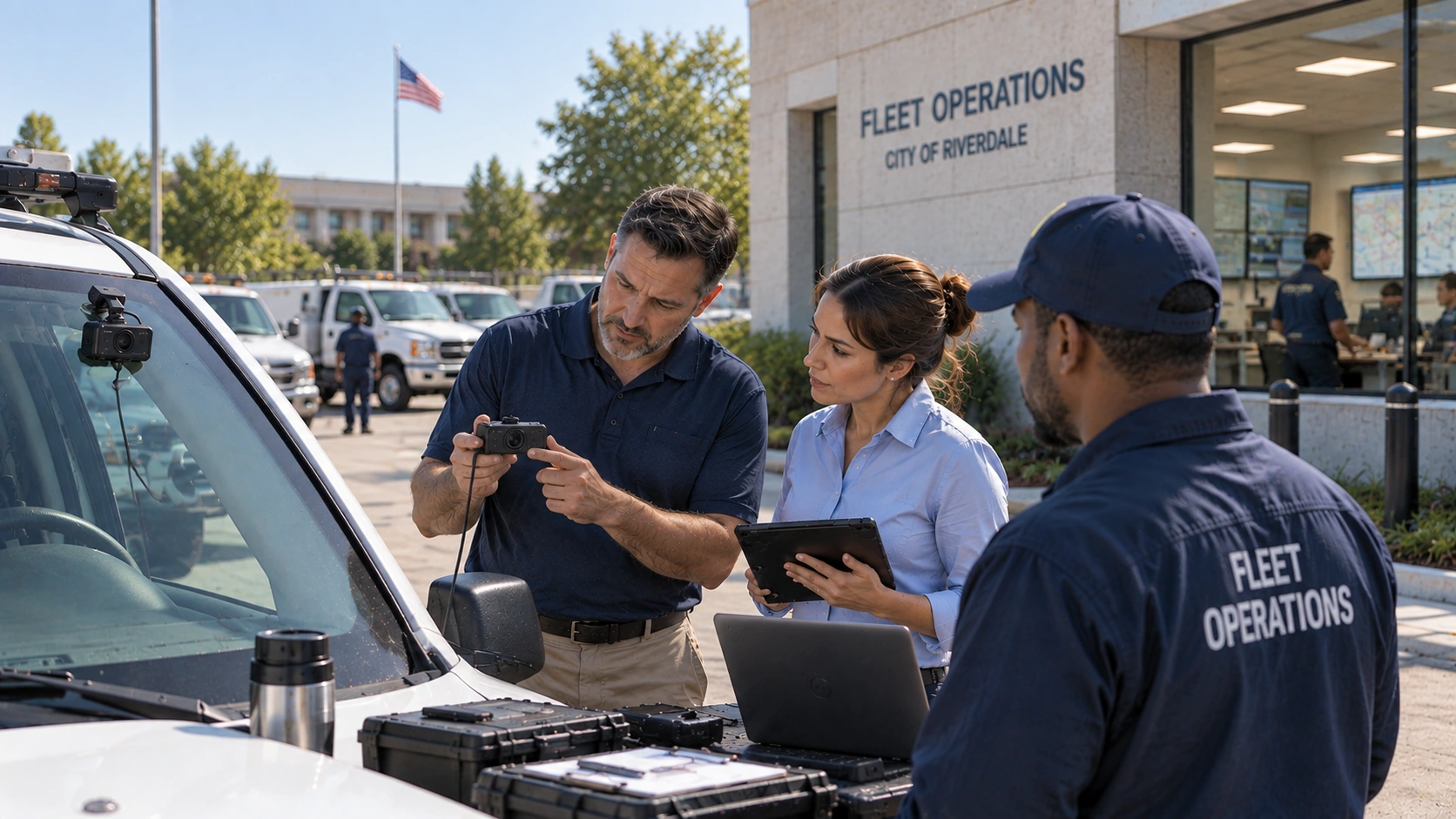
A federal fleet should review several security areas before adopting a telematics or cloud based system:
- FedRAMP authorization and applicable agency security requirements
- Protection and appropriate handling of personally identifiable information
- Encryption of information at rest and in transit
- Role based access and authentication controls
- Security logs, monitoring, and auditability
This matters because telematics can expose location, vehicle activity, driver related information, and operational patterns. Security review therefore belongs in the procurement process, not after deployment.
FMIS Requirements for State, County, and Municipal Fleets
Most state, county, and municipal fleets do not submit annual fleet data through FAST. Their exact requirements depend on state law, grant terms, purchasing rules, records requirements, audit standards, and local policy. Still, the federal FMIS model gives public fleets a useful benchmark for deciding what their own system should capture.
Even without a federal reporting mandate, a public fleet can adopt the same core practices:
- Maintain one accountable record per vehicle
- Track cost and utilization at the asset level
- Preserve lifecycle maintenance and fuel history
- Keep records searchable and exportable
- Integrate telematics rather than managing it separately
This becomes especially valuable when several departments maintain different spreadsheets or naming conventions. Fleets dealing with that problem can compare their process with the common government fleet decisions caused by spreadsheets and identify where fragmented data is weakening accountability.
AUTOsist can serve as the asset level record, maintenance, inspection, fuel, cost, and document layer for state, county, municipal, and federal adjacent fleets working toward this data standard. It should not be presented as a replacement for GSAFleet.gov, FedFMS, or FAST for federal agencies. Public organizations planning their architecture should first define the required data model and workflow before selecting tools, as outlined in a practical approach to building a fleet management system.
Common FMIS Compliance Gaps and How to Close Them
Most FMIS problems are not caused by a complete absence of data. They happen because the information exists but cannot be connected, validated, exported, or traced to one accountable asset.
| Common Gap | Why It Happens | How to Close It |
|---|---|---|
| Data scattered across spreadsheets | Departments track vehicles independently | Establish one master vehicle record and shared data standards |
| Missing lifecycle cost per asset | Finance and maintenance costs use different identifiers | Tie every transaction to a unique vehicle ID |
| No usable export or audit trail | System was designed only for daily operations | Require structured exports, history, and change visibility |
| Telematics not integrated | GPS data stays in a separate portal | Import or reconcile telematics against the asset record |
| Vehicle record created late | Acquisition handoff between departments is unclear | Assign record creation ownership and deadline controls |
| Multiple records for one vehicle | Teams use different names or unit numbers | Establish a single authoritative identifier and duplicate checks |
Fragmented information also makes audits harder because managers have to prove where a number came from. Reviewing why government fleet records fail audits can help identify whether the problem is missing data, inconsistent ownership, weak record history, or poor retrieval.
The best correction is usually process discipline before new technology. Define who creates a vehicle record, who validates costs, who reconciles mileage and fuel, who reviews exceptions, and who owns the final reporting dataset.
Choosing an FMIS That Meets Government Requirements
Start with the data model rather than the feature list. A system should make every important operational event traceable to the individual vehicle and should allow managers to retrieve that information without rebuilding it manually.
Use the following capability checklist during evaluation:
- Asset level inventory and unique vehicle records
- Lifecycle maintenance and cost tracking
- Cost per mile and fuel cost by vehicle
- Reporting, structured export, and audit history
- Fuel card and telematics integration
- Mobile inspection capture
- Vehicle document management
- Role based user access
Records also need to remain available when the supporting document is not a maintenance transaction. Centralized vehicle document management can help keep registrations, receipts, inspection records, supporting files, and other asset documentation connected to the correct vehicle.

For federal agencies, the final system architecture must still align with the government provided environment. GSAFleet gov agency owned FMIS is a compliant option, and federal guidance also directs agencies without an existing compliant system toward FedFMS at no additional cost. FAST remains the federal reporting tool.
For state and local managers, the same standard can work as a practical readiness test. If you can identify one vehicle, reconstruct its lifecycle cost, verify its mileage and fuel, retrieve its supporting records, and export the data without rebuilding the history manually, your information system is doing what a government fleet needs it to do. A consistent government fleet monthly tracking process helps keep that readiness intact throughout the year.
Frequently Asked Questions
-
Does every federal agency need an FMIS?
Yes. Federal agencies must maintain an FMIS at the department or agency level that collects accurate vehicle inventory, cost, and use data across the complete vehicle lifecycle. -
What data must an FMIS track for each vehicle?
An FMIS should track vehicle identity, acquisition, mileage, utilization, fuel use, operating and maintenance costs, and disposal data at the individual asset level. -
Is FAST the same as an FMIS?
No. The FMIS stores and manages the agency's vehicle data. FAST is the federal reporting tool agencies use to submit required annual fleet data. -
Does an FMIS need to integrate telematics data?
Current federal guidance expects an FMIS to support vehicle level telematics data so mileage, utilization, fuel, location, and related information can feed the agency's fleet records. -
Do state and local government fleets have to follow federal FMIS requirements?
Generally, no. The federal FMIS mandate applies to federal agencies, but state and local fleets may face separate state rules, grant requirements, audit standards, purchasing conditions, and public records obligations.