 Miya Bholat
Oct 12, 2026
Fleet Recall Management: Track Open Recalls

Fleet recall management means identifying open safety recalls for every vehicle, evaluating their risk, arranging necessary repairs, and recording completion against each vehicle identification number (VIN). The most reliable approach combines regular VIN checks with a documented fleet maintenance process, so recalled vehicles do not continue operating with unresolved safety defects. This helps fleet managers protect drivers, prevent avoidable downtime, and maintain accurate repair records.
Key Takeaways
- Track recalls by VIN: Each vehicle needs an individual recall check because identical models may have different recall histories.
- Prioritize by safety risk: Follow manufacturer warnings immediately and evaluate safety critical defects before continuing operations.
- Check continuously: New recalls can appear after a vehicle enters service, making one time checks insufficient.
- Manage unavailable remedies: Document interim safety instructions, restrict vehicles when necessary, and follow up until repairs become available.
- Close recalls with evidence: Record the recall number, repair date, service provider, and proof of completion.
- Assign clear ownership: One responsible person should monitor recalls, coordinate repairs, and report unresolved cases.
Why Open Recalls Are a Fleet Problem, Not Just a Consumer One
A single driver might miss one recall notice. A fleet manager could miss dozens across vehicles from different manufacturers, model years, and locations.
According to a January 2025 CARFAX analysis of unfixed vehicle recalls, approximately 58.1 million vehicles in the United States had at least one unresolved recall. That represented roughly one in five vehicles, a 16% increase over two years. More than 14 million had multiple outstanding recalls.
The problem continues. NHTSA reported that 997 safety recalls affected more than 29 million vehicles in 2025.
For fleets, each outstanding recall represents another decision about driver safety, repair scheduling, and vehicle availability. This becomes especially important in school bus fleet management, where unresolved safety defects can affect vehicles carrying passengers.
What "Open" Actually Means (Open vs Incomplete vs Remedied)
Recall status describes whether the manufacturer identified a defect and whether the prescribed correction has been completed.
| Recall status | Meaning | Fleet action |
|---|---|---|
| Open | A recall applies, and the remedy remains outstanding | Assess risk and arrange repair |
| Incomplete | The required remedy has not been completed | Keep tracking until resolved |
| Remedy not yet available | The manufacturer has not released the required solution | Follow interim instructions and monitor |
| Remedied | The prescribed recall repair was completed | Verify and retain completion evidence |
An open recall does not automatically mean a vehicle must stop operating. However, fleet managers must assess the actual defect and follow any manufacturer restrictions.
How to Find Every Open Recall Across Your Fleet
Start with a complete inventory of active vehicle VINs. The VIN identifies the exact vehicle configuration and helps determine whether a particular recall applies.
Year, make, and model searches can identify potential recalls, but they cannot reliably confirm every affected vehicle.

Use the official NHTSA vehicle recall lookup to check individual VINs. Record the recall number, defect description, remedy availability, and current status.
Make recall verification part of the vehicle onboarding and periodic inspection process rather than relying entirely on mailed notices.
Manual NHTSA Checks vs Continuous Monitoring
Fleet managers can choose between three approaches depending on fleet size, administrative capacity, and operating risk.
| Approach | Best for | Main weakness |
|---|---|---|
| Manual NHTSA VIN lookup | Small fleets with limited vehicles | Requires repeated individual checks |
| Spreadsheet recall register | Fleets needing basic status tracking | Manual updates can become outdated |
| Continuous automated monitoring | Larger or frequently changing fleets | Requires reliable VIN data and follow through |
Automation can identify possible matches faster, but it cannot decide whether a vehicle is safe to operate or confirm that a dealer actually completed the repair.
Even with automated monitoring, fleet managers should establish a routine vehicle inspection process to identify visible defects and driver reported safety concerns that recall databases might not explain.
The Blind Spot: Vehicles Added Mid Campaign
Used vehicles, leased units, and transfers from another branch can arrive with outstanding recalls.
A fleet manager may assume the previous owner or leasing provider already addressed them. That assumption creates an avoidable gap.
Before placing a newly acquired vehicle into service, check its VIN, review available manufacturer recall information, and request supporting repair records. Record unresolved campaigns during onboarding, including any restrictions that affect deployment.
Triage: Which Open Recalls Ground a Vehicle and Which Can Wait
Not every recall carries the same immediate risk. However, every safety recall requires action, and a fleet manager should never treat a low priority classification as permission to ignore it.
Use the recall instructions, operating conditions, and likelihood of failure to decide whether to remove the vehicle from service or arrange an urgent repair.
| Risk category | Examples | Recommended response |
|---|---|---|
| Immediate restriction | Manufacturer Do Not Drive warning or other explicit operating prohibition | Stop affected operation immediately |
| Special safety instruction | Fire risk with Park Outside warning | Follow parking and operating instructions exactly |
| Safety critical | Brake, steering, or tire defects | Assess immediately; remove from service if unsafe |
| Lower immediate risk | Recall without an immediate operating restriction | Schedule promptly while following manufacturer guidance |
A Park Outside warning does not always mean Do Not Drive. Follow the specific instructions for that recall rather than applying a blanket rule.
When a defect could compromise control or safe operation, the decision should follow the same principles used to determine whether a fleet repair needs immediate attention.
When the Remedy or Parts Are Not Available Yet
A manufacturer may announce a recall before replacement parts or repair instructions are ready.
Keep the recall open and document the manufacturer guidance, current parts status, contact date, and expected follow up.
If the manufacturer prohibits driving, stop operating the vehicle. For other defects, evaluate potential restrictions, alternative vehicle assignments, and exposure during normal duty cycles.
Parts shortages may create longer service delays, so fleet managers should incorporate recall cases into their existing maintenance downtime planning rather than leaving affected vehicles in an unmonitored waiting status.
What the Law Actually Requires of Commercial Fleets
Commercial fleet recall obligations are more nuanced than simply saying every open recall automatically makes a vehicle illegal to operate.
Under federal motor vehicle safety recall law, owners of vehicles already in service generally do not face a universal requirement to complete every recall repair immediately. Manufacturers must provide qualifying recall remedies without charge, subject to applicable statutory rules.
However, this does not eliminate other safety obligations.
FMCSA can require specific commercial vehicles with unresolved recalls to be placed out of service when the defect creates an unacceptable safety risk. In 2016, the agency directed inspectors to remove certain unrepaired recalled trucks from operation.
Commercial vehicles with mechanical conditions likely to cause accidents or breakdowns can also be declared out of service during roadside inspections. A recall alone does not automatically trigger that result.
Operating a vehicle with a known dangerous defect can also increase negligence and liability exposure if the defect contributes to an incident.
Sale and rental requirements differ. Federal law restricts delivery of affected new vehicles by dealers and rental of covered recalled vehicles by rental companies, subject to specified exceptions. Used vehicle resale rules and recall disclosure duties vary by jurisdiction and transaction. The governing framework appears in 49 U.S.C. Section 30120.
For fleet managers, the practical conclusion is straightforward: limited blanket federal repair mandates do not mean limited safety or financial exposure.
Clear vehicle maintenance records also help establish what the organization knew, when it acted, and how it addressed the identified defect.
Turning a Recall Notice Into a Tracked Repair
A recall should move through the normal maintenance process, not disappear into a separate inbox or spreadsheet.
The goal is to connect the recall notice, affected VIN, repair assignment, and completion record.
Recall Repair Workflow
A structured fleet maintenance work order allows managers to assign responsibility, follow repair progress, and avoid losing track of pending appointments.
AUTOsist can serve as the maintenance system of record for tracking work orders, storing related documents, and keeping completed repair information connected to each vehicle.
Documenting Completion for Audits, Resale, and Warranty
A repair appointment is not proof that a recall was resolved.
The completion record should identify the affected VIN, recall campaign, repair date, servicing facility, and work performed. Where available, retain the manufacturer or dealer confirmation that the campaign is closed.
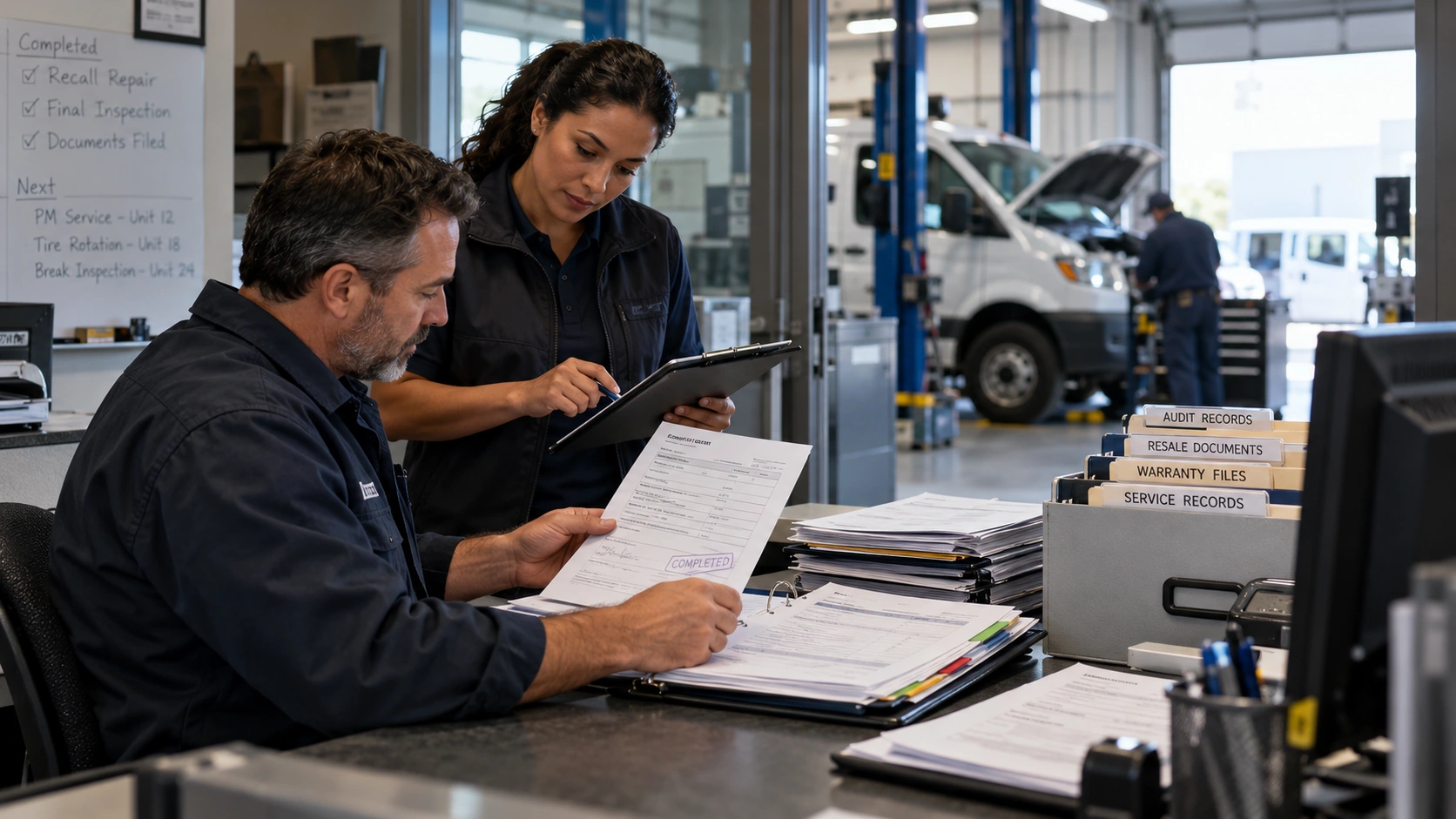
Organizing this evidence in a vehicle document management system makes records easier to retrieve during internal reviews, resale transactions, and compliance inspections.
It also prevents completed recall work from being mistaken for outstanding maintenance when vehicles change locations or ownership.
Building a Repeatable Recall Tracking Process
Recall management works best when it becomes an assigned operating responsibility rather than an occasional administrative task.
Designate a fleet maintenance coordinator or safety manager to maintain VIN accuracy, review new notices, and escalate serious findings.
For active fleets, a monthly internal review provides a practical management checkpoint. NHTSA recommends that owners check recalls at least twice annually, but fleet managers may reasonably choose more frequent checks based on operational exposure.
Track the process using a small set of measurable indicators.
| Metric | What it reveals |
|---|---|
| Open recalls by severity | Current exposure requiring attention |
| Average age of open recalls | How long cases remain unresolved |
| Recall completion status | Progress toward verified closure |
| Cases awaiting parts | External repair delays |
| Restricted vehicles | Immediate operational impact |
Use a fleet reports dashboard to review outstanding work and completion progress. Recall specific reporting may require configured records or custom categorization.
Review the highest risk cases first, confirm follow up ownership, and verify that completed work has supporting evidence.
A good recall process does not end when a notification arrives. It ends when the correct vehicle receives the required remedy and the organization can prove it.
Frequently Asked Questions
-
How often should fleet managers check for open recalls?
Fleet managers should check recalls whenever vehicles enter the fleet and review outstanding cases regularly. Monthly checks are a practical fleet policy, while NHTSA recommends checking vehicle recalls at least twice a year. -
Can a fleet vehicle operate with an open safety recall?
It depends on the defect and applicable restrictions. Follow manufacturer instructions immediately, especially Do Not Drive warnings. A known safety defect may also require removing the vehicle from service under commercial vehicle safety rules. -
What if recall repair parts are not available?
Follow the manufacturer's interim safety instructions and ask the authorized dealer about availability. Record the delay, restrict vehicle use when necessary, and follow up until the repair is completed. -
Why does a vehicle show no open recalls when its model has been recalled?
Not every vehicle of the same model is affected. Recall eligibility depends on the specific VIN, production period, and components. Newly announced recalls may also take time to appear in VIN lookup results. -
Why does a recall still appear open after the repair?
The manufacturer's recall database may not have been updated yet. Keep the completed repair documentation and contact the servicing dealer or manufacturer to confirm that the recall was properly closed.