 Miya Bholat
Oct 19, 2026
From Failed Inspection to Work Order: A Fleet Workflow

When a fleet inspection item fails, the next step is to assess its severity, determine whether the vehicle can operate, and create an assigned work order with the original defect details attached. A connected fleet maintenance software workflow helps managers move from the failed inspection to an actionable repair without losing photos, vehicle information, or accountability. The goal is to close the gap between discovering a defect and completing the repair.
Key Takeaways
- Classify the failed item immediately. Determine whether the defect requires a vehicle hold, restricted operation, or scheduled maintenance.
- Preserve the inspection evidence. Carry the failed component, description, photos, and original inspection record into the work order.
- Give every repair an owner. Assign a technician or vendor, set priority, and establish a completion target.
- Connect vehicle status with repair status. Prevent dispatch from assigning vehicles with unresolved safety critical defects.
- Measure defect to repair time. Track how long each failed item takes to reach completed repair, not just how quickly someone acknowledges it.
- Keep the records connected. Link the repair outcome to the original inspection and the vehicle's maintenance history.
What "Failing" an Inspection Actually Means for a Fleet
A failed inspection means an inspector identified a component or condition that did not meet the applicable inspection criteria. It does not automatically mean the entire vehicle must stop operating.
The consequence depends on what failed, how serious the condition is, and which inspection standards apply.
For a maintenance supervisor, the important question is what happens after the failed item enters the system. A defect that remains inside an inspection form without a repair assignment creates an unresolved operational risk.
Roadside Failure vs. Internal Inspection Failure
A roadside DOT inspection and an internal fleet inspection can identify similar defects, but they create different immediate responsibilities.
During a roadside inspection, an enforcement officer may identify a violation that meets out of service criteria. The vehicle cannot continue operating until the fleet resolves the applicable violations.
An internal inspection may flag a defect without automatically placing the vehicle out of service. A qualified person must assess the finding and decide what operation, if any, remains safe and permitted.
The scale of roadside findings shows why that decision matters.
According to CVSA's 2025 International Roadcheck results, inspectors conducted 56,178 inspections across North America from May 13 to 15, 2025. They placed 10,148 commercial motor vehicles out of service, an overall vehicle out of service rate of 18.1%.
Brake systems and the category covering 20% defective brakes accounted for 41.1% of vehicle out of service violations. Inspectors also recorded 2,899 tire related out of service violations, representing 21.4% of the total.
For daily inspections, the DVIR report process provides additional context on how drivers document vehicle conditions. The workflow here begins once an inspection item actually fails.
Why a Failed Item Needs More Than a Checkbox
Imagine a technician opening an inspection record that says, "Brakes: Fail."
Which axle has the problem? What did the inspector observe? Is the vehicle parked or still assigned to a route?
The technician cannot act confidently without those details.
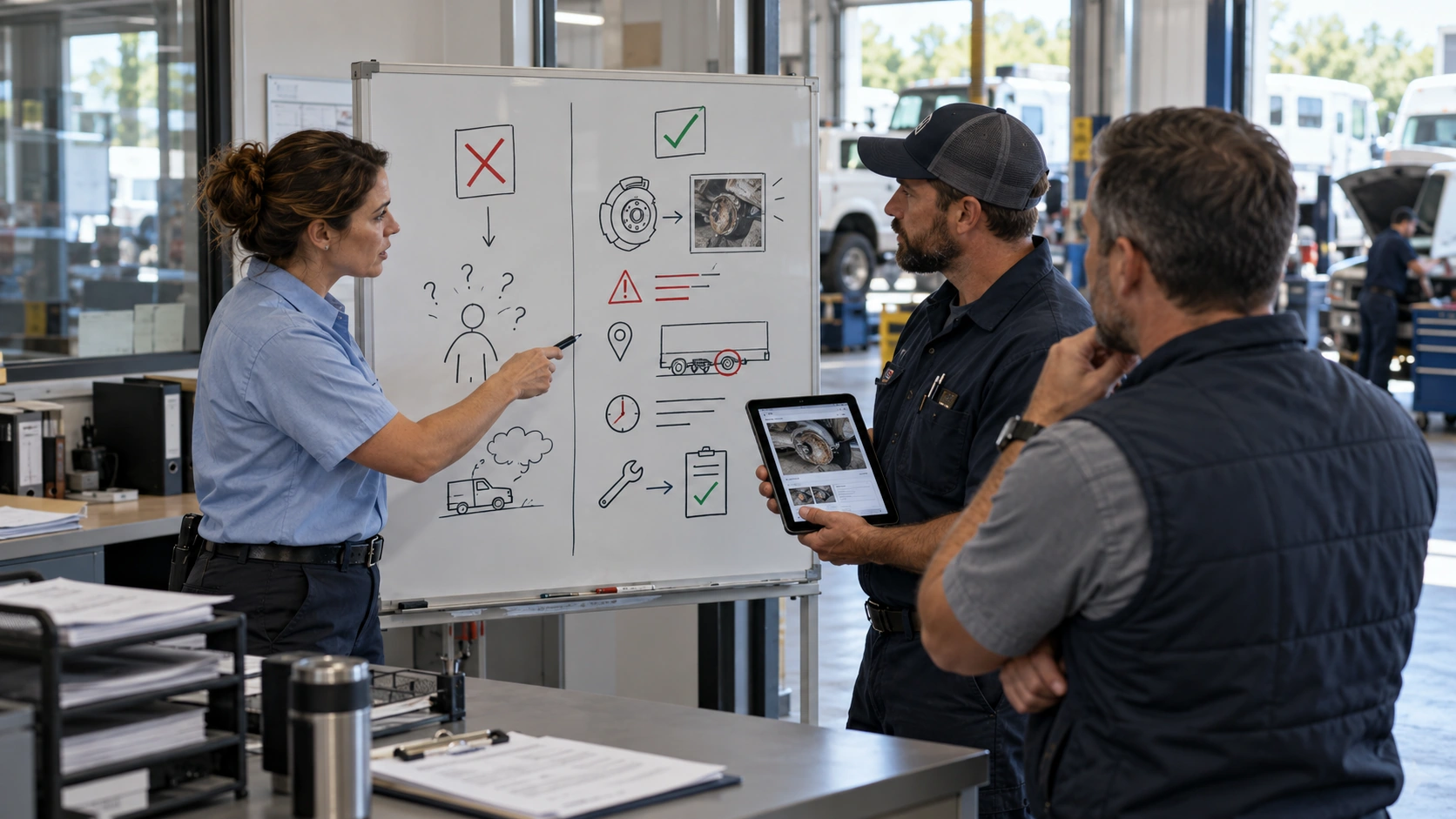
A useful failed item identifies the component, describes the condition, and includes supporting evidence. Digital vehicle inspections can capture comments, images, and submission details while notifying maintenance personnel about failed items.
The inspection should provide enough information to begin the repair process without another round of calls to the inspector.
Step One: Triage the Failed Item by Severity
The first decision after an inspection failure is whether the vehicle can continue operating.
A maintenance supervisor should assess the defect against safety risk, applicable inspection criteria, and operating conditions. The vehicle's importance to operations must never override an unsafe condition.
A simple severity table gives every shift the same starting point.
| Severity | Failed Item Examples | Required Action |
|---|---|---|
| Critical | Loss of braking ability, severe tire damage, steering failure | Hold the vehicle, escalate immediately, and arrange repair |
| Urgent | Intermittent warning indicator, deteriorating component requiring prompt assessment | Restrict operation as necessary, obtain qualified assessment, and prioritize repair |
| Scheduled | Minor cosmetic damage, defective nonessential accessory | Keep in service only when safe, create a repair task, and set a deadline |
These categories represent an internal operating framework, not a substitute for legal out of service criteria.
A fleet should use consistent vehicle defect severity levels so inspectors, dispatchers, and technicians understand what each decision means.
Record who assessed the failure, when the decision occurred, and why the vehicle received its operating status. If the severity remains uncertain, hold the vehicle until a qualified person can evaluate it.
Step Two: Turn the Failed Item Into a Work Order
Once the fleet identifies the defect and its severity, the inspection record must produce an actionable maintenance task.
The strongest workflow transfers the original inspection information into the work order rather than asking another employee to type everything again.
A connected fleet work order system helps teams create maintenance tasks from failed inspection items, add supporting information, assign technicians, and track progress.
AUTOsist supports this connection between inspections and maintenance work orders, including technician assignments, notes, images, and status updates.
Failed inspection to work order workflow
The following numbered sequence establishes a repeatable process from discovery to assignment.
If an inspection contains several failures, the fleet may create separate work orders or group related repairs. Each failed item must remain traceable to its resolution.
The Anatomy of a Work Order a Technician Can Actually Use
A technician should be able to open the work order and understand which vehicle needs attention, what failed, and what to inspect first.
Every work order originating from a failed inspection should include the following information.
- Asset identification: Unit number, vehicle identification number when available, and asset type.
- Meter reading: Odometer mileage or engine hours recorded during the inspection.
- Failed component: Specific inspection item and affected vehicle system.
- Defect description: Observed symptoms, condition, and relevant operating circumstances.
- Supporting evidence: Photos, inspection comments, and supporting documents.
- Severity and priority: Risk classification, operating restriction, and repair urgency.
- Inspection origin: Inspector identity, inspection location, and original failure date and time.
- Linked inspection record: Inspection reference or identifier that connects the repair to the original failed item.
- Repair ownership: Assigned technician or vendor, instructions, and expected completion date.
For example, "Rear left tire has exposed cord near the shoulder" gives a technician a more useful starting point than "Tire failed."
Accurate fleet repair request details reduce clarification calls and help the shop prepare parts, tools, and labor before the vehicle enters the bay.
Where Manual Handoffs Break the Chain
Paper inspections and disconnected spreadsheets create several opportunities for information to disappear.
A driver submits a form, a supervisor photographs it, and someone else manually creates a maintenance ticket. The new ticket may contain the vehicle number but omit the photo, original timestamp, or exact failed component.
The technician then spends time reconstructing the problem instead of assessing it.
Duplicate entry creates another issue. Two employees may create separate work orders for the same failure, while neither references the original inspection.
The practical solution is one defect record with a persistent identifier that connects every related repair action. Even when systems cannot transfer information automatically, the fleet should require a consistent reference and verify that the supporting evidence reached the technician.
Step Three: Assign, Prioritize, and Hold the Vehicle if Needed
Creating a work order is not the same as assigning responsibility.
A maintenance supervisor must identify who will perform the repair, determine its place in the shop queue, and confirm whether dispatch can use the vehicle.
Start with safety and applicable operating restrictions. Then consider vehicle criticality, technician availability, required parts, and repair complexity.
A consistent process for prioritizing fleet work orders helps supervisors make these decisions without treating every failed item as equally urgent.
For a critical defect, the supervisor should place an explicit dispatch hold on the vehicle and notify operations. The hold should remain until the appropriate repair verification and release authorization occur.
This coordination matters especially for public works fleet management, where vehicles may move between departments, shifts, and maintenance locations.
The work order should show whether it is awaiting assignment, awaiting parts, under repair, or completed. The dispatcher should see the current vehicle restriction separately from the repair progress.
Step Four: Measure Defect to Repair Time
Defect to repair time measures the elapsed time between recording a failed inspection item and completing the associated repair.
It shows whether the fleet actually resolves inspection findings promptly, rather than simply moving them into a maintenance queue.
Defect to repair time = Repair completion timestamp minus failed inspection timestamp
Consider this example.
A vehicle fails an internal brake inspection at 10:00 AM Monday. The supervisor assigns the repair that afternoon. A technician completes the repair at 2:00 PM Tuesday.
The defect to repair time equals 28 hours.
Even if the technician spent only two hours completing the repair, the fleet still needed 28 hours to resolve the defect. That difference reveals time spent waiting for review, assignment, parts, or shop capacity.
Use these supporting measurements to identify where delays occur.
| Metric | Calculation | What It Reveals |
|---|---|---|
| Defect to repair time | Repair completed minus failure recorded | Total repair resolution time |
| Triage delay | Severity decision minus failure recorded | Delay before assessment |
| Assignment delay | Work order assigned minus failure recorded | Delay before ownership |
| Open defect age | Current time minus failure recorded | How long unresolved items have waited |
There is no universal acceptable defect to repair time. A critical brake defect, a scheduled cosmetic repair, and a vehicle awaiting specialized parts require different expectations.
Set targets by severity, compare median completion times, and review the slowest cases separately. Exclude neither weekends nor parts delays from elapsed time, but label these causes so managers understand the results.
Repeated failures may also reveal opportunities to improve preventive maintenance scheduling.
Closing the Loop Without Losing the Record
After completing the repair, the technician should document the work performed, parts used, relevant findings, and completion time.
The final record should connect back to the original inspection failure and remain accessible through the vehicle's service history. That connection allows fleet managers to identify recurring defects and review previous repairs without searching through separate files.

Repair completion does not automatically mean the vehicle can return to service. The fleet must complete the applicable verification and authorization steps before removing restrictions.
For detailed FMCSA repair certification and driver acknowledgment requirements, refer to what happens after a driver reports a safety defect.
Common Breakdowns in the Failed Inspection to Work Order Workflow
Most failures in this process occur between inspection submission and repair assignment. Watch for these common breakdowns and apply the corresponding fixes.
- Failed item without context: Require a description and supporting evidence for actionable failures.
- No severity decision: Assign a responsible reviewer and record the operating status.
- Work order missing inspection details: Transfer the original defect information and inspection reference.
- Duplicate repair tasks: Check existing open work orders for the same asset and component.
- Unassigned work order: Require an owner and target date before the task enters the active queue.
- Vehicle dispatched with an unresolved critical defect: Maintain a visible dispatch restriction until authorized release.
- Repair completed without traceability: Record the outcome against the original inspection item.
A weekly review of unresolved failed items can expose these gaps before they become repeat defects or extended downtime.
Final Takeaways for Fleet Managers
A failed inspection should start a controlled maintenance workflow, not another round of paperwork.
Classify the failure, preserve its evidence, create a complete work order, assign ownership, and maintain the appropriate vehicle restriction until the fleet authorizes release.
Most importantly, track defect to repair time by severity. It reveals whether your inspection program produces completed repairs or simply generates more open tasks.
Frequently Asked Questions
-
Does every failed inspection item need a separate work order?
No. Related defects can share one work order, but each failed item must remain individually traceable to its repair or documented resolution. -
What if the same defect appears in multiple inspections?
Link the new finding to the existing open work order, update the evidence, and reassess severity instead of creating duplicate repair tasks. -
Can a vehicle operate with an open inspection work order?
Yes, if the defect does not prevent safe or legally permitted operation. Safety critical defects require appropriate restrictions until resolved. -
When should a failed inspection item be marked resolved?
Only after the fleet verifies the repair or documents why no repair is necessary. Creating or assigning a work order does not resolve the defect. -
Does waiting for parts count toward defect to repair time?
Yes. Measure from the original failure timestamp to completed repair, including parts delays. Track waiting time separately to identify bottlenecks.