 Miya Bholat
Nov 11, 2026
How Long Should a Fleet Vehicle Inspection Take?

A daily light duty vehicle inspection should take about 5 to 10 minutes, while a Class 8 tractor trailer pretrip typically takes 20 to 30 minutes. These are planning ranges, not legal minimums. Fleet safety compliance procedures help managers set expectations, document checks, and review rushed inspections.
During its 2026 International Roadcheck, the Commercial Vehicle Safety Alliance (CVSA) reported 10,350 vehicles placed out of service, representing 19% of all inspections conducted. Brake and tire defects were prominent. A walkaround cannot reveal every hidden failure, but rushing makes visible problems easier to miss.
Key Takeaways
- No federal minimum duration exists. FMCSA regulates vehicle condition and driver responsibilities, not a fixed number of inspection minutes.
- The vehicle and inspection type set the pace. A van check is shorter than a tractor trailer inspection with air brakes and coupling systems.
- Fifteen minutes is a useful tractor pretrip benchmark. It is a carrier practice reference, not a DOT requirement or a universal safe minimum.
- Inspection labor is predictable. Missed brake or tire defects can lead to an unpredictable out of service interruption.
- Duration helps reveal rushed work. Review unusually short times alongside defect findings, photos, and inspection records.
How Long a Fleet Vehicle Inspection Takes, by Inspection Type
A light duty daily check needs about 5 to 10 minutes; a tractor trailer combination pretrip needs 20 to 30 because it covers more systems.
Fleet Inspection Time Budget Table
| Inspection type | Who does it | Planning time range | What drives the time |
|---|---|---|---|
| Light duty daily check, pickup, van or car | Driver | 5 to 10 min | Lights, tires, fluids, visible damage |
| Straight truck or tractor pretrip | Driver | 15 to 20 min | Air brakes, steering, coupling check |
| Tractor trailer combination pretrip | Driver | 20 to 30 min | Second unit, brake and light circuits |
| Hazmat, flatbed or specialty equipment | Driver | 30 min or more | Securement, placards, PTO or boom checks |
| Posttrip inspection and DVIR | Driver | 10 to 15 min | Defects found during the shift |
| Annual periodic inspection under 49 CFR 396.17 | Qualified inspector or shop | Set by shop job times | Full component standard and records |
These are AUTOsist planning ranges, not federal time standards. Calibrate them locally. A 2019 Transport Topics report described Ruan auditing driver logs for at least 15 minutes per inspection, with hazmat and flatbed work commonly needing about 30 minutes. That is carrier practice, not regulation.
A CVSA roadside Level I inspection is a separate enforcement process, not a driver's daily check. The pretrip versus posttrip inspection requirements clarify each driver's duties.
Why FMCSA Sets No Minimum Inspection Time (and What It Does Require)
FMCSA sets no fixed driver inspection duration; its rules focus on vehicle safety and driver responsibilities.
Under 49 CFR 392.7, drivers must be satisfied that brakes, steering, lights, tires, and other specified equipment work properly. Under 49 CFR 396.13, drivers review the previous report and sign when defects were noted to acknowledge the repair certification.
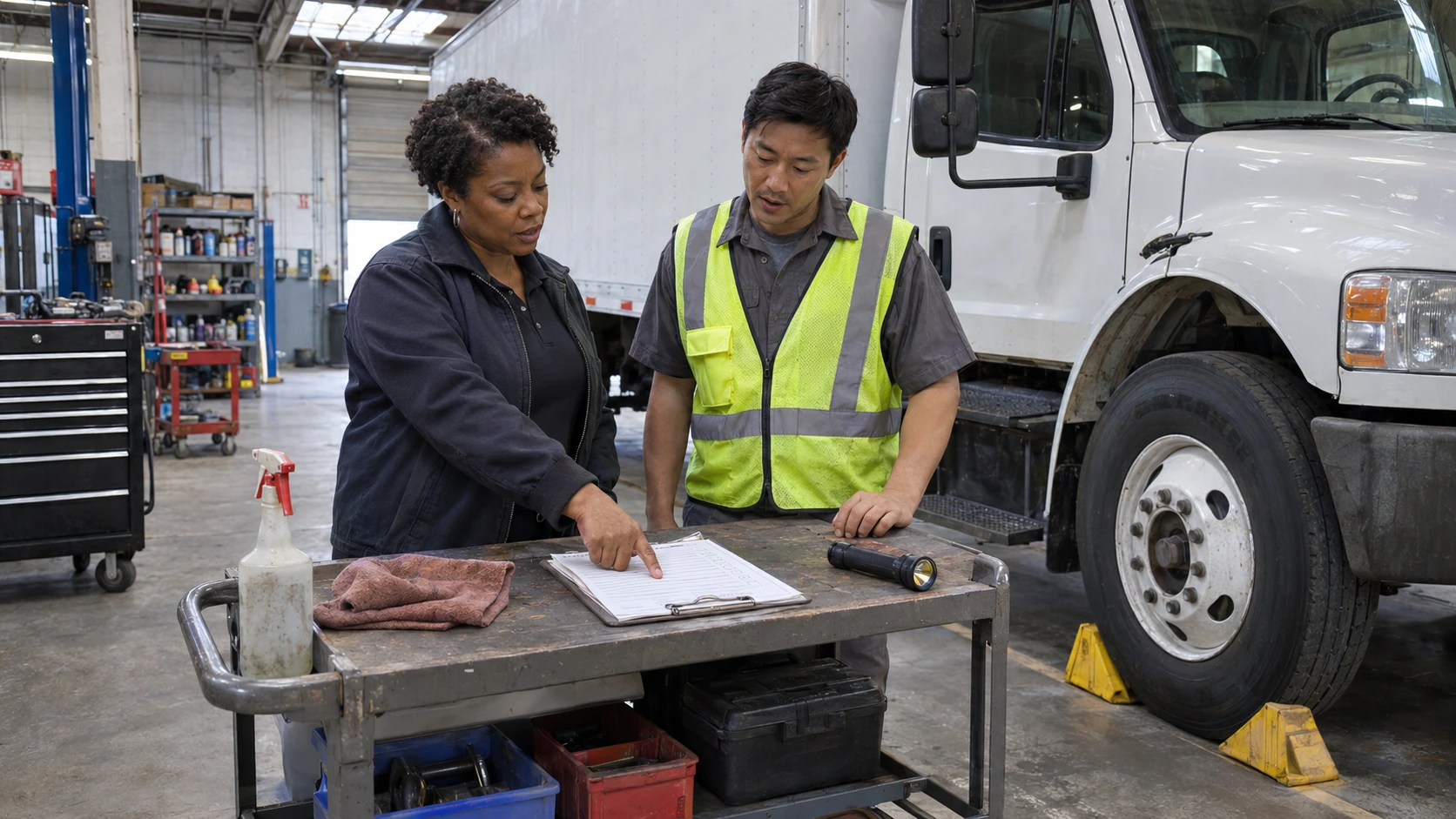
Under 49 CFR 396.11, property carrying drivers report qualifying defects in writing. Since 2014, property carriers generally need no written report when no defect exists, while passenger carriers must still report. The driver vehicle inspection report process explains the details.
For drivers subject to federal hours of service rules, inspections count as on duty time within the 14 hour window. Dispatch must allow for them.
FMCSA's 2014 paperwork reform estimated 46.7 million annual DVIR paperwork hours, worth $1.7 billion. The change removed unnecessary forms, not vehicle checks.
7 Factors That Make an Inspection Take Longer or Shorter
Inspection time depends on vehicle complexity, conditions, and documentation. Even vehicles on the same route may need different budgets.
The main factors are:
- Units and axles: More wheels, tires, and connections need attention.
- Air brakes: Pressure tests and related components add steps.
- Cargo: Hazmat placards and flatbed securement increase scope.
- Special equipment: Lift gates, PTO systems, booms, and plows require additional checks.
- Existing defects: The previous report may require verification before dispatch.
- Site conditions: Poor lighting, bad weather, and scattered parking slow access.
- Recording method: Paper forms and duplicate entry add administrative time.
Experienced drivers work faster without skipping items. New drivers need time to learn. In construction fleet operations, attachments and muddy sites justify longer standards than a service van route.
How to Set an Inspection Time Standard for Your Fleet
Set standards using timed inspections plus equipment specific allowances. The Base Plus Add On Time Budget makes that repeatable.
Start With a Base Walkaround Time
Start with tires, lights, brakes, steering, fluids, glass, mirrors, and safety equipment. Base time means completing these checks under normal conditions, not racing through a form.
Add Time for Units, Systems and Paperwork
Add time for trailers, air brakes, securement, hazmat, specialty equipment, and documentation. A tractor walkaround plus trailer checks and recording should fit the combination range if observations support it.
Adapt a fleet vehicle inspection form to each vehicle type. Irrelevant items waste time; missing safety checks create risk.
The 5 Step Calibration Workflow
What Inspection Time Costs (and Why It Is the Wrong Place to Save)
Inspection time is predictable labor expense; a missed defect can sideline a vehicle. Saving time matters only when checks remain complete.
Take 50 drivers over 250 days, each with a 20 minute pretrip and 10 minute posttrip. The U.S. Bureau of Labor Statistics reported May 2024 median driver pay of $27.62 hourly for heavy and tractor trailer drivers.
May 2024
Worked example: Annual inspection labor cost
| Daily inspection time | 20 + 10 = 30 min |
|---|---|
| Annual time per driver | 30 min × 250 days = 125 hr |
| Annual wage cost per driver | 125 hr × $27.62 = $3,452.50 |
| Annual wage cost for 50 drivers | 50 × $3,452.50 = $172,625 |
Saving 5 minutes per driver each day
About $575/year
Approximately 20.8 hours saved per driver annually
This is wage cost only. CVSA's 2026 Roadcheck found 5,451 brake related out of service violations, about 39% of vehicle out of service violations, plus 2,914 tire violations. Those systems deserve full attention.
The American Transportation Research Institute's 2026 operating cost report found record 2025 trucking costs of $2.336 per mile, with repair and maintenance costs up 8.6%.
No inspection prevents every failure. Finding unsafe tires or brakes before departure still creates a repair opportunity.
Define when to take a fleet vehicle out of service and never penalize drivers for spending extra time on a real defect.
When a Fast Inspection Is a Red Flag
An inspection completed far below the normal time may mean the driver checked boxes instead of equipment. This is often called pencil whipping, but duration alone cannot prove that it happened.
The most useful warning signs are:
- Durations consistently below the review floor across a crew.
- Start and finish timestamps only a minute or two apart.
- Identical responses without comments over repeated inspections.
- Missing photos where the checklist requires evidence.
- Defects found in the shop or roadside that the last inspection missed.
Review these signals alongside the fleet inspection defect rate, not just individual completion times. A driver who consistently reports zero defects is not automatically careless, and a long inspection is not automatically thorough.

FMCSA estimated in 2014 that about 95% of DVIRs reported no defects. Compare timestamps with vehicle condition, photo evidence, and later shop findings before questioning a driver. A clean report may reflect a properly maintained vehicle.
The goal is to detect patterns that make fleet inspection records hard to trust and investigate the work behind them, not to punish a driver for being efficient on a familiar unit.
Key outcomes from monitoring duration:
- Identify inspections that deserve a targeted quality review.
- Recognize classes and yards where schedules are unrealistic.
- Compare reported defects against actual maintenance findings.
How to Shorten Inspections Without Cutting Corners
The safest way to shorten inspections is to remove wasted movement, repetitive forms, and missing information. Never remove a required check just to reach a faster completion time.
A digital vehicle inspection app can present the relevant checklist, record timestamps, and keep documentation with the vehicle. Pair that with a fixed route around the vehicle so drivers inspect each component once rather than backtracking.
Practical improvements include:
- Show vehicle specific checks so van drivers do not scroll through tractor items.
- Arrange checklist items in the physical order of the walkaround.
- Require photos and notes for selected safety critical findings.
- Display the last DVIR and unresolved defects before inspection starts.
- Send failed items directly for maintenance review.
- Fix recurring defects so drivers stop reporting the same issue every day.
Connect failed checks to fleet maintenance work orders so the shop sees the issue without waiting for a paper handoff. Keep repair status and service history available before the next driver accepts the vehicle.
Supervisors should walk the process with drivers periodically. If a timed check gets shorter because the yard is better arranged or previous reports are easier to find, that is a real efficiency gain. If it gets shorter because brake or tire checks disappear, the process needs correction.
Key outcomes from a better inspection workflow:
- Less administrative time without weaker safety checks.
- Faster routing of reported defects to maintenance.
- More consistent evidence that inspections actually occurred.
Frequently Asked Questions
-
How long should a DOT pretrip inspection take?
A straight truck or tractor typically needs 15 to 20 minutes, while a tractor trailer combination may need 20 to 30 minutes. These are planning ranges, not DOT minimums. -
Does DOT require at least 15 minutes for a pretrip inspection?
No. FMCSA does not prescribe a minimum inspection duration. The 15 minute convention comes partly from older paper logging practices. Drivers must complete the necessary safety checks regardless of time. -
Does pretrip inspection time count against hours of service?
Yes. Inspection time counts as on duty, not driving, time. For drivers subject to federal hours of service rules, it must be recorded accurately and accounted for in scheduling. -
How long should a posttrip inspection take?
A routine posttrip inspection generally takes 10 to 15 minutes. Allow additional time when defects are discovered, and record the actual inspection duration. -
Is a DVIR required if no defects are found?
Generally, no. Federal rules no longer require no defect DVIRs for property or passenger carriers. However, a fleet may still require drivers to submit them under company policy.