 Miya Bholat
Nov 25, 2026
Hybrid Fleet Maintenance: Running In-House & Vendor Repairs
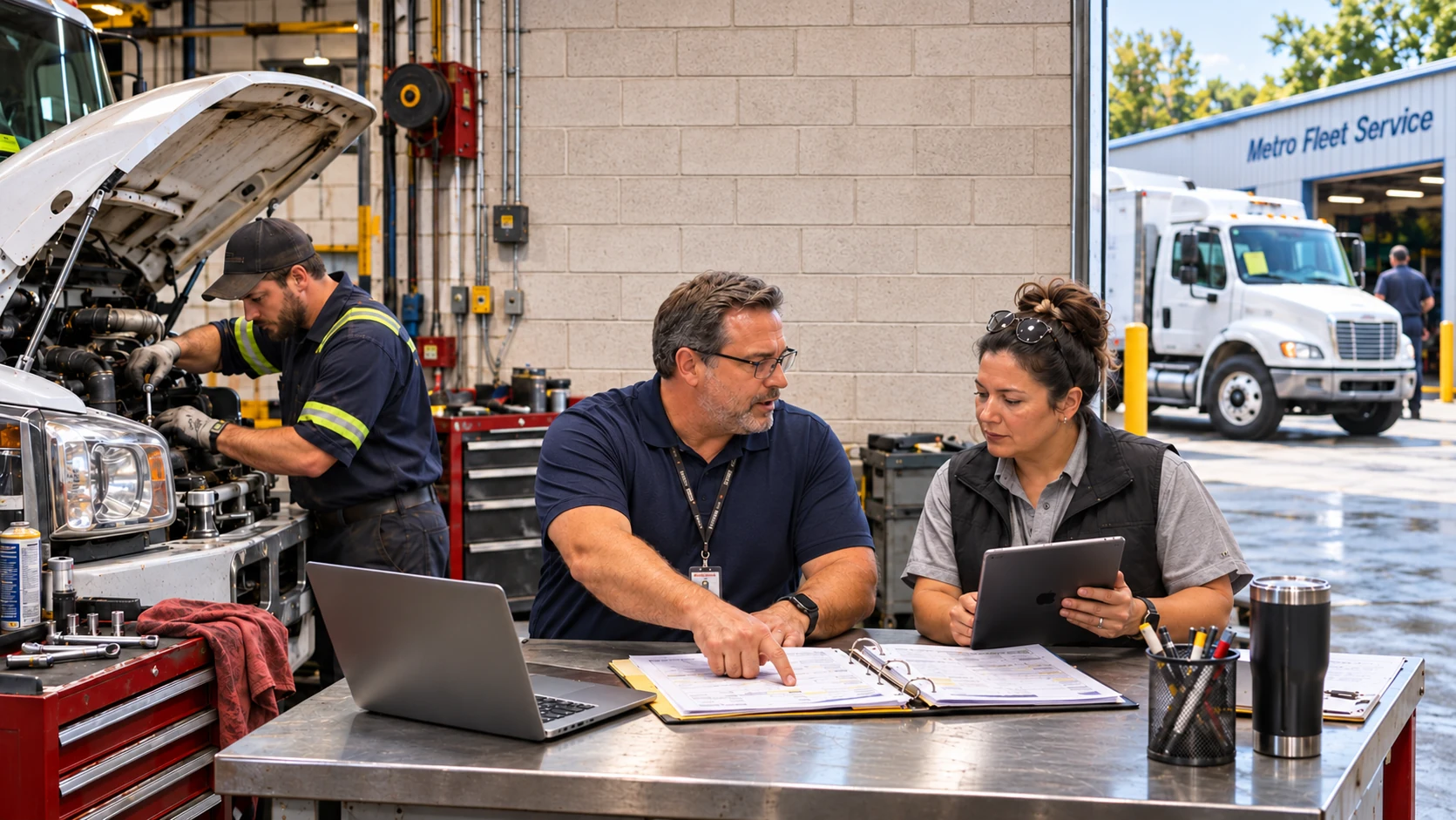
Hybrid fleet maintenance means routing each repair to your own shop or an outside vendor according to capability, capacity, total cost and accountability, then tracking both channels in a single record. A practical fleet maintenance software program connects repair requests, decisions and completed work so neither side operates blind.
The NPTC 2026 Benchmarking Survey found that 77% of private fleets outsourced at least part of their maintenance budget during 2025 operations. If you are still choosing a model, start with the decision framework. This article covers running the mix job by job.
Key Takeaways
- Route every repair individually. Check capability, available time, complete cost and comeback ownership before assigning work.
- Use a loaded shop labor rate. Include labor burden and productive utilization before comparing your shop with vendor pricing.
- Keep one repair record. Require identical service details from internal technicians and outside shops.
- Watch for vendor creep. Repeated outsourcing can hide declining shop productivity and unchecked spending.
- Rebalance quarterly. Use routing reasons, downtime, quality and capacity to adjust the maintenance mix deliberately.
Why Running a Hybrid Maintenance Program Got Harder in 2026
Two repair channels require daily coordination as staffing and vehicle needs change. The NPTC 2026 Benchmarking Survey found that 35% of fleets outsourced nearly all maintenance while 22% handled all or nearly all work internally. Subtracting those groups from 100% suggests roughly 43% operate a meaningful mix, a calculation from NPTC 2026 figures.
Both channels face capacity pressure. ATRI's 2025 technician shortage research reported 65.5% of shops understaffed, with 19.3% of positions unfilled on average. The U.S. Bureau of Labor Statistics 2025 outlook also projected about 24,400 diesel technician openings annually through 2034.
Specialized failures also complicate assignment. The NPTC 2026 Benchmarking Survey identified emissions equipment in 58% of reported breakdown cases, so the shop that is free tomorrow may not be the shop with the right diagnostic access.
The Four Gate Dispatch Check for Routing Every Repair
Use four checks before assigning any repair. The in house versus outsourced maintenance decision provides a default work type list; these gates handle exceptions such as absent technicians or delayed parts.
Gate 1: Can Your Shop Do This Job Right?
Check certifications, experience, diagnostics and tooling first. Your technicians might replace a sensor but lack software for aftertreatment diagnosis.
Gate 2: Can Your Shop Do It Inside the Downtime Window?
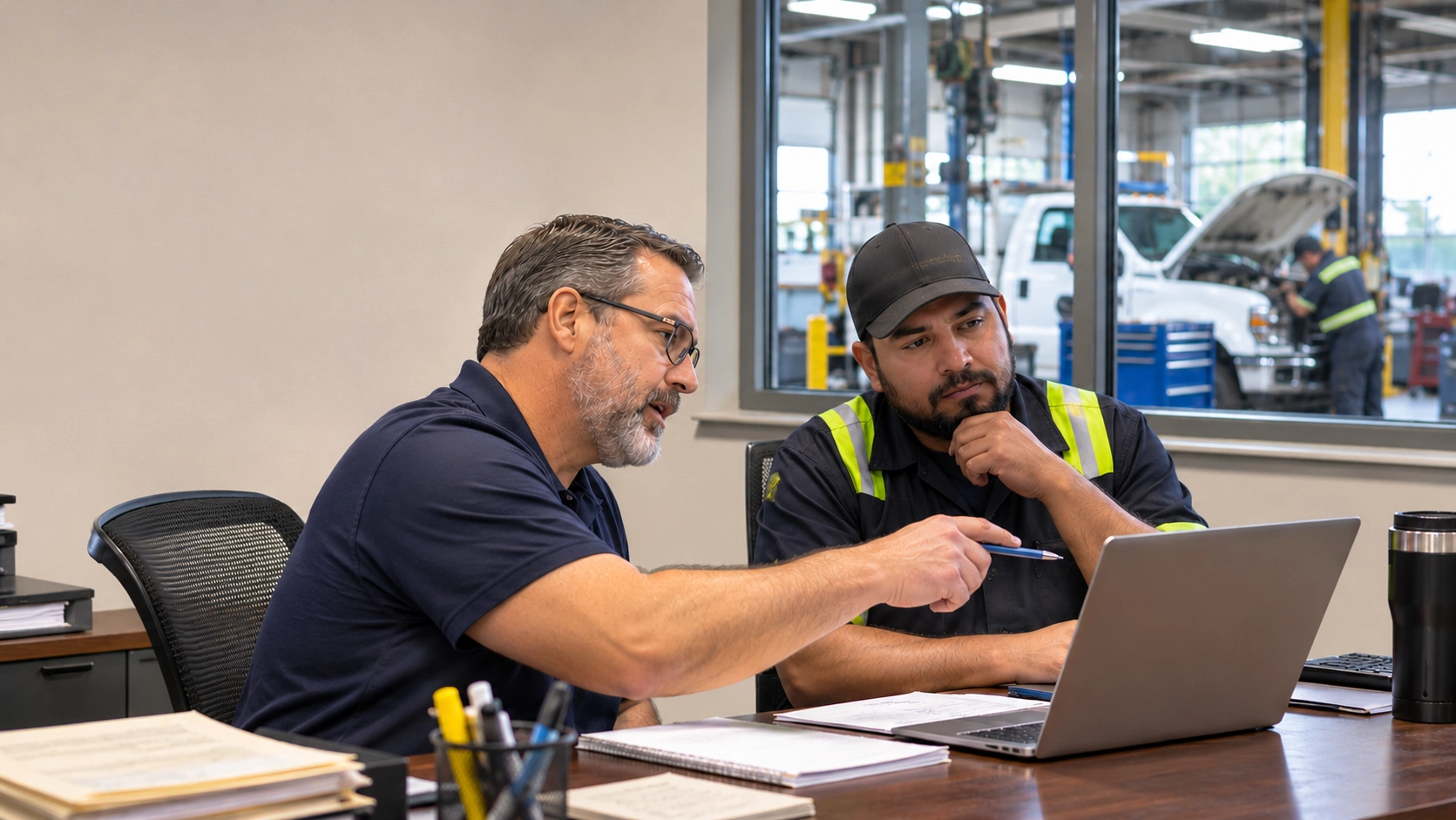
Check bay hours, technicians, parts and the next route. If your shop cannot start until Thursday, a vendor returning the truck tomorrow may win.
Gate 3: Which Channel Costs Less All In?
Compare internal labor and downtime with vendor charges, transport and return date. A cheaper hourly rate may not mean a cheaper job.
Gate 4: Who Owns the Comeback?
Confirm warranties, OEM coverage and comeback responsibility. Send covered work to the required provider even if an internal repair looks cheaper.
Use this dispatch workflow when a driver reports a defect:
- Capture the complaint, vehicle ID, mileage and urgency.
- Confirm safety status and whether the vehicle can remain in service.
- Test shop capability at Gate 1 and available completion time at Gate 2.
- Compare complete job costs at Gate 3 and warranty responsibility at Gate 4.
- Assign the internal technician or approved vendor and agree on a completion target.
- Record the deciding gate, approver and assignment in the maintenance work order.
The routing note explains why a job went outside when you review costs later.
How to Compare In House vs Vendor Cost on a Single Job
Compare total job cost rather than posted labor rates. Include productive labor, transport and downtime for identical repair scopes.
Calculate Your Loaded Shop Labor Rate
Loaded rate = base technician wage × burden factor ÷ productive utilization. The U.S. Bureau of Labor Statistics May 2024 wage data provides a historical median diesel technician wage of $29.15 per hour. Using illustrative inputs of a 1.4 burden factor for benefits, taxes, tools and facility share, and 70% productive utilization, the calculation is $29.15 × 1.4 ÷ 0.70 = $58.30 per productive hour. Replace both assumptions with your shop's actual figures.
Two Jobs, Two Different Answers
These are illustrative examples, not benchmarks. Parts costs are assumed equal and excluded; downtime costs an illustrative $400 per day.
| Illustrative repair | In house total | Vendor total |
|---|---|---|
| Job A: Brake job | 3 hours × $58.30 = $174.90 labor; 1 day × $400 = $400 downtime; $574.90 total | 3 hours × $150 = $450 labor; $60 shuttle; 3 days × $400 = $1,200 downtime; $1,710 total |
| Job B: Aftertreatment diagnostic and repair | 9 hours × $58.30 = $524.70 labor; 2 days × $400 = $800 downtime; $1,324.70 total | 4 hours × $150 = $600 labor; $60 shuttle; 1 day × $400 = $400 downtime; $1,060 total |
In Job A, the shop wins by $1,135.10. In Job B, the vendor wins by $264.70 through faster diagnosis. Downtime drives both results, connecting Gates 2 and 3.
The ATRI 2026 operational costs report found that repair and maintenance costs rose 8.6% in 2025 to 21.5 cents per mile. That pressure makes avoidable downtime and repeat repair costs worth measuring at the job level.
Keeping One Repair Record Across Your Shop and Every Vendor
Both channels need equivalent records. Otherwise the next technician may miss the vendor's diagnosis, parts and warranty.
Send the vendor the complaint, service history, related prior repairs and approval limit before work starts. A defined intake package prevents the repair handoff problems that delay maintenance when a provider must request missing details after the vehicle arrives.
Require the following details back before closing any outside work order:
- Labor hours broken out by repair task.
- Parts descriptions and part numbers.
- Diagnosed failure cause or repair code.
- Odometer reading or engine hours.
- Warranty coverage for parts and labor.
- Technician notes and final invoice matched to the approved estimate.
Attach that package to the vehicle's complete service history, with work orders and vendor documents. Staff can then trace repeat defects across both repair channels.
Where Hybrid Fleet Maintenance Breaks Down
Hybrid programs falter when shops and vendors follow different standards. Look for these failures before costs rise.
Vendor creep. Dispatchers send work outside because it is easier than fixing internal scheduling. Vendor share grows every quarter even when the shop has the tools and skills to take the work back.
PM drift. Technicians get reassigned to urgent repairs, so scheduled services slip and preventable failures create more outside jobs. Protect the fleet preventive maintenance schedule with reserved capacity rather than using PM slots as open repair time.
Comeback ping pong. The vendor blames the last internal repair while your technician blames the vendor's replacement part. Assign one person to investigate the original failure and enforce warranty responsibility.
Split history. An invoice stays in email and never reaches the vehicle record. The next technician repeats diagnostic steps and may replace a component that another shop already tested.
Approval bottlenecks. The vendor has the vehicle and estimate but cannot proceed until someone signs off. Clear spending thresholds and backup approvers address the maintenance approvals that slow down repairs.
An assigned repair owner should check status changes, verify that the vendor has the required parts and record revised return dates. No one should assume the other repair channel is handling the follow up.
Even after approval, a repair can stall while a provider waits for a part or silently changes its completion date. Track promised versus actual return dates, and use the vendor repair delays teams can prevent as checks during active jobs, not just after invoice review.
How to Rebalance Your In House and Vendor Mix Every Quarter
Review the maintenance mix quarterly rather than repeating old routing habits. The Fleet Advantage 2025 Transportation Industry Benchmark Survey, published in 2026, found that 62% of fleets named unpredictable maintenance costs as a top concern and 45% struggled to track total ownership cost or cost per mile.
Fleet Advantage
Pull the same five measures each quarter:
- Vendor spend share by repair type.
- Internal shop productive utilization.
- Comeback rate for each repair channel.
- Average vehicle downtime days by channel.
- Work orders routed out and the gate that decided each assignment.
Recheck repeat jobs against current workload. Include warranty outcomes and the quality measures on your fleet maintenance vendor scorecard so a cheaper invoice cannot conceal repeat failures.
Signals to Pull Work Back In-House
Bring a repair category back when it goes outside regularly, volume and spend stay predictable, and training or tooling can pay back within a year. A higher vendor comeback rate on comparable jobs provides another reason to test a controlled internal pilot.
Do not move the entire category at once. Start with jobs your available technicians can complete safely within the required return window, then confirm that expected downtime and quality actually improve.
Signals to Push More Work Out
Increase vendor use when occupied bays consistently delay PM, a technician vacancy remains open or new emissions systems exceed the shop's training and diagnostic capability. ATRI's 2025 technician research found an average 19.3% of diesel technician positions unfilled, a reminder that planned internal capacity may not be real capacity.
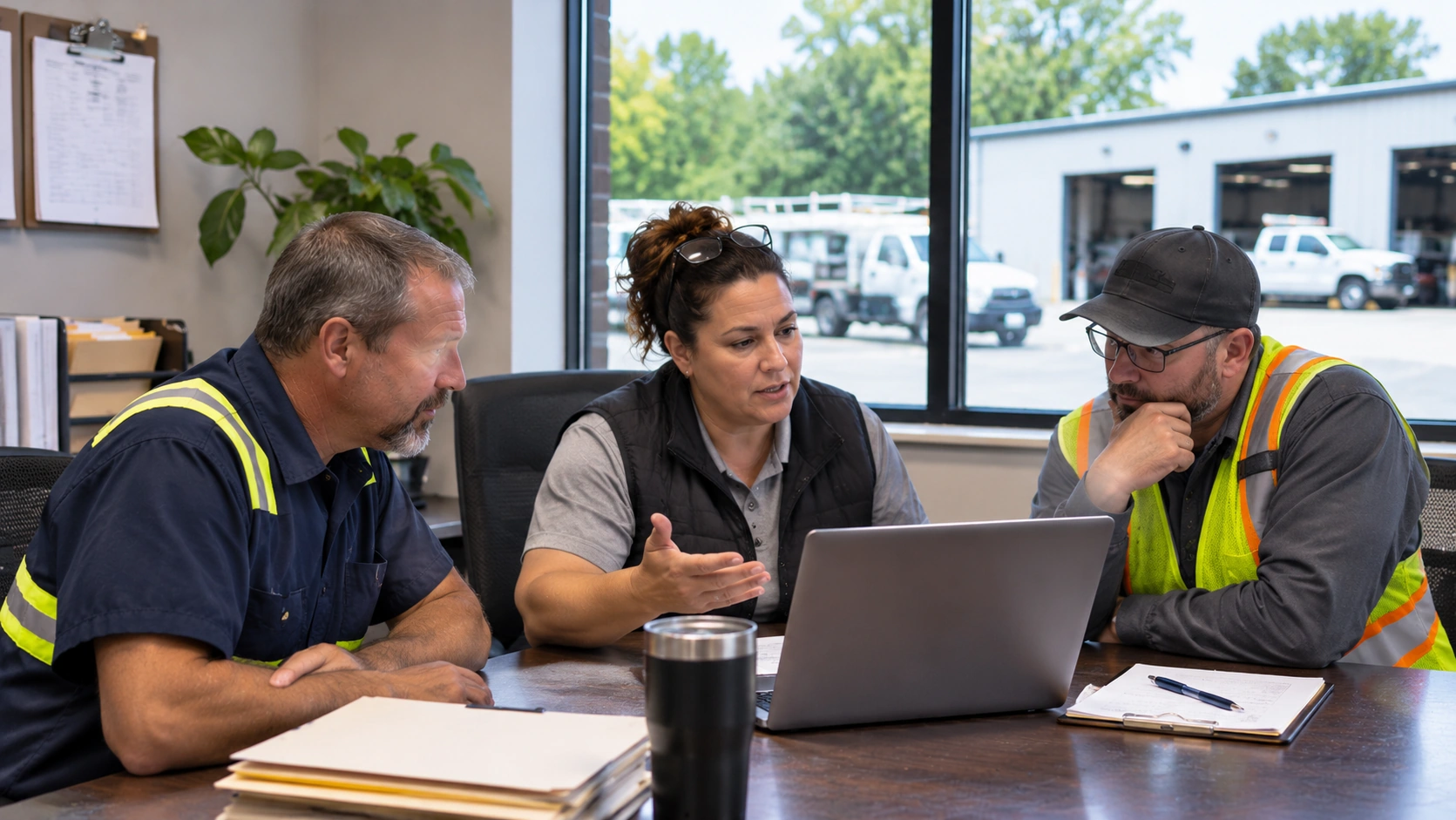
Before expanding the vendor roster, use a documented fleet maintenance vendor onboarding process to confirm equipment capability, turnaround commitments, billing detail, warranty handling and escalation contacts. Recheck the resulting work after the next quarterly cycle instead of assuming the switch solved the issue.
Making Your Hybrid Model Run Like One Program
A controlled hybrid program gives every repair the same routing rules and record standards, whether the work happens inside or outside.
Use this operating checklist to keep the two channels aligned:
- Run every new repair through the four dispatch gates.
- Compare fully loaded job costs and expected downtime.
- Close every job with equivalent repair documentation.
- Investigate vendor creep, PM drift and repeat failures.
- Adjust routing rules and vendor capacity every quarter.
Fleet maintenance software keeps job ownership, history and repair outcomes visible across both channels.
Frequently Asked Questions
-
What if our in-house shop cannot finish a repair on time?
Send the repair to a qualified vendor if they can return the vehicle sooner at an acceptable total cost. Confirm the vendor's actual start date, parts availability and expected completion time before assigning the job. -
How do you know if outsourcing a fleet repair will reduce downtime?
Compare the complete turnaround time for both options, including scheduling delays, parts delivery, repair hours and transport. Ask the vendor when work will actually begin, not just how long the repair takes. -
Who is responsible if an outsourced fleet repair fails?
Responsibility depends on the vendor's workmanship warranty, parts warranty and approved repair agreement. Document the repeated failure, review the original repair order and confirm whether the vendor must correct it without additional charges. -
What repair records should outside maintenance vendors provide?
Require an itemized invoice, labor hours, parts and part numbers, diagnosed failure, mileage, technician notes and warranty details. Attach these documents to the vehicle's service history so internal technicians can review previous work before starting another repair. -
When should a fleet bring outsourced maintenance back in-house?
Bring work back when repair volume becomes predictable, your technicians have sufficient capacity, and internal costs and downtime compare favorably with vendor performance. Review repeat repair categories quarterly before investing in additional training or equipment.