 Miya Bholat
Oct 20, 2026
Ambulance Fleet Standardization: What Should Be Consistent?
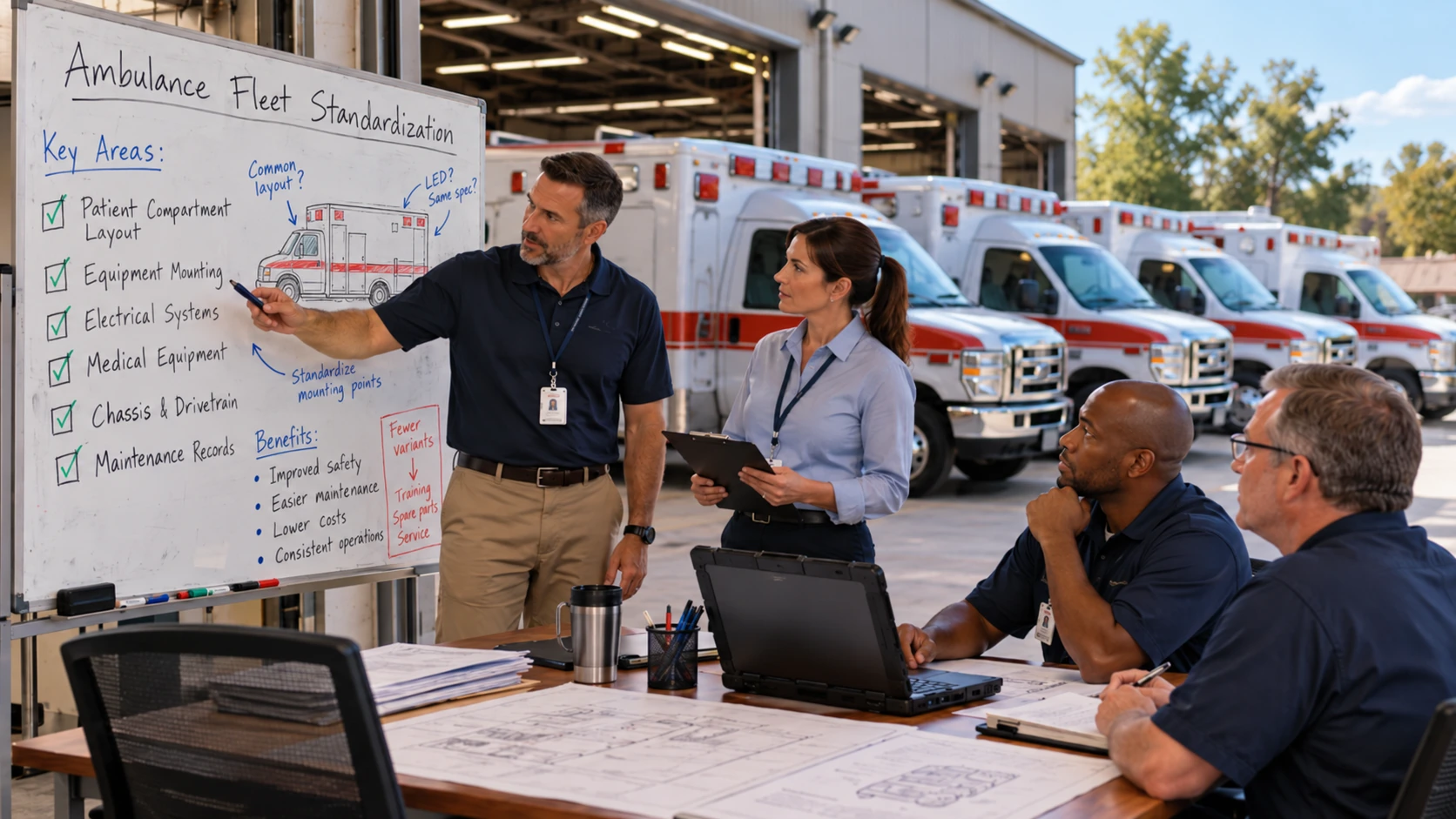
Ambulance fleet standardization means keeping critical vehicle specifications consistent across units, including chassis configurations, patient compartment layouts, equipment mounting, medical devices, electrical systems, and maintenance records. The goal is to make ambulances safer, easier to operate, and less expensive to maintain without requiring every vehicle to be identical. A structured fleet management software approach helps managers maintain that consistency throughout each vehicle's service life.
For an EMS agency operating a mixed fleet, the priority should be patient compartment layout and equipment security first, followed by chassis commonality, medical equipment compatibility, and replacement specifications. Standardization works best when managers introduce changes during scheduled repairs, remounts, and vehicle replacements rather than replacing functioning ambulances simply to achieve uniformity.
Key Takeaways
- Standardization is a safety and lifecycle decision. Consistent vehicle specifications improve crew familiarity, reduce maintenance complexity, and support predictable replacement costs.
- Start with the highest operational risks. Patient compartment layouts, equipment mounting, electrical safety, and critical medical equipment deserve attention before cosmetic details.
- Consistent layouts support patient safety. Paramedics should find essential equipment in familiar locations regardless of which ambulance they operate.
- Remountable modules offer financial flexibility. A properly designed patient compartment can potentially transfer to a replacement chassis, reducing dependence on entirely new ambulance purchases.
- Common components simplify maintenance. Standard chassis configurations and equipment models can reduce spare parts variety, mechanic training requirements, and repair delays.
- Documentation protects long term consistency. Accurate specifications, configuration records, and service histories prevent undocumented changes from gradually undermining the standard.
What Ambulance Fleet Standardization Actually Means
Ambulance fleet standardization means creating repeatable vehicle specifications that support safe clinical operations, reliable maintenance, and predictable ownership costs. Effective EMS and ambulance fleet management requires consistency in the details crews and technicians depend on every day.
That does not mean every ambulance needs the same body type or capacity. A transport unit and a specialty response vehicle may require different configurations. Standards such as CAAS GVS, applicable NFPA requirements, and state EMS licensing rules establish important requirements, while the agency determines which configurations should remain consistent beyond those minimums.
Standardization vs. Over-Customization
Standardization establishes an approved specification with documented exceptions. Overcustomization allows individual vehicles or departments to introduce different cabinet positions, equipment models, wiring arrangements, and accessories without a clear operational need.
Every unnecessary variation increases training requirements, complicates repairs, and potentially extends procurement timelines. Agencies should separate vehicle specification decisions from standardizing fleet management processes, since each solves a different problem.
The practical rule is simple: approve customization when it addresses a documented clinical, accessibility, environmental, or operational requirement. Otherwise, use the established fleet specification.
Why Standardization Matters More Under Today's Cost and Supply Pressure
Ambulances represent major capital investments, and procurement uncertainty makes inconsistent specifications especially expensive.
During earlier chassis supply disruptions, Firehouse reported built to order ambulance lead times of 14 to 24 months compared with historical periods of 3 to 6 months. These figures describe that earlier disruption, not a verified nationwide 2026 average.
Recent public procurement records show the financial stakes. In May 2026, the Town of Castle Rock, Colorado, documented a proposed ambulance purchase costing $356,560. Its official council record also described a standardized replacement schedule of five years or 75,000 miles and the value of keeping equipment consistent across vehicles.
Higher acquisition costs make fleet replacement planning essential. Managers need to account for future chassis availability, module condition, repair expenses, and funding before a replacement becomes urgent.
The Remount Advantage
A remount transfers a suitable ambulance patient compartment module onto a replacement chassis. This can extend the useful life of the module and reduce the need for an entirely new vehicle.
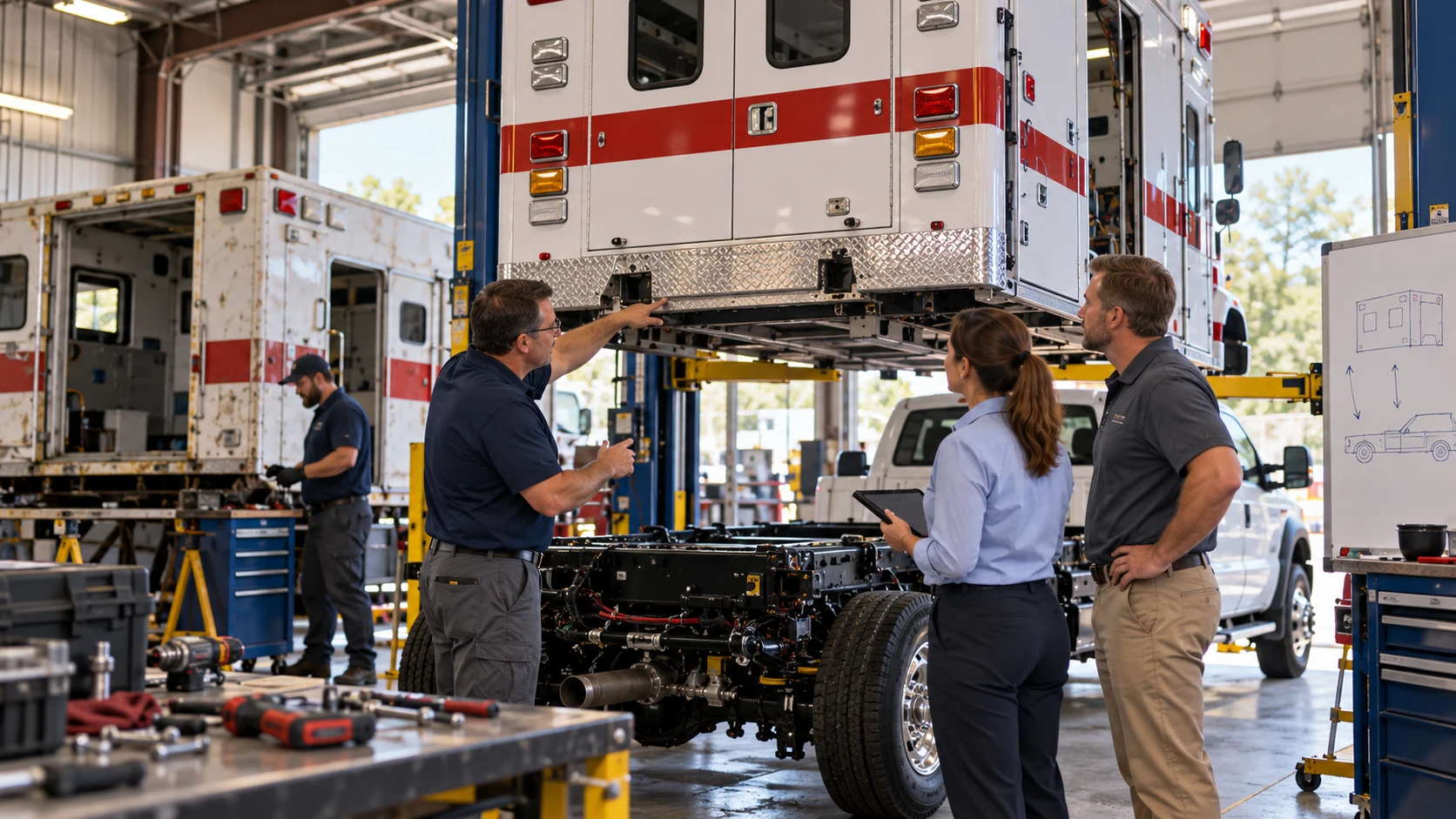
The CAAS Ground Vehicle Standard V4.0 became effective July 1, 2025, and includes updated remount provisions, electrical specifications, structural requirements, and vehicle security measures. Separately, CAAS Accreditation Standards Version 4.0 became mandatory for accreditation submissions beginning January 1, 2026.
Remounting is not automatically the cheaper option. Managers must evaluate module integrity, chassis compatibility, payload capacity, current safety requirements, refurbishment costs, and remaining useful life.
Before authorizing a remount, compare its projected lifecycle expense with a new ambulance using a consistent fleet repair versus replacement analysis.
What Should Be Standardized First (The Priority Framework)
Start with the vehicle characteristics that influence patient care, crew safety, downtime, and repair complexity. The following table provides a practical priority order for a mixed ambulance fleet.
| Standardization Category | What It Covers | Primary Payoff | Priority |
|---|---|---|---|
| Patient compartment layout | Cabinets, oxygen access, workstations, seating | Crew familiarity and patient safety | 1 Critical |
| Equipment mounting and brackets | Stretcher restraints, monitors, oxygen mounts | Equipment security and safe access | 1 Critical |
| Electrical and power systems | Batteries, charging, shore power, outlets | Reliability and electrical safety | 1 Critical |
| Documentation and spec records | Build sheets, wiring diagrams, approved changes | Consistency and traceability | 1 Critical |
| Medical equipment models | Monitors, suction units, stretchers | Training and compatibility | 2 High |
| Chassis and drivetrain | Engine, transmission, chassis components | Parts and maintenance savings | 2 High |
| Warning and lighting systems | Light controls, sirens, scene lighting | Familiar controls and simpler repair | 2 High |
| Graphics and livery | Markings, colors, identification | Recognition and appearance | 3 Lower |
Suggested prioritization framework. Mandatory safety and regulatory requirements override these operational rankings.
Safety-Critical Consistency (Standardize These First)
A paramedic moving between ambulances should not need to search different cabinets for essential equipment during patient care.
Patient compartment consistency is particularly important when agencies rotate crews, operate reserve ambulances, or transfer personnel between stations.
A standardized clinical compartment should establish:
- Consistent locations for frequently used medical equipment.
- Approved mounting positions and restraint systems.
- Accessible oxygen, suction, and emergency supplies.
- Predictable controls, seating positions, and safe working spaces.
This vehicle specification decision complements daily ambulance readiness tracking, which verifies whether the required equipment is present and operational before deployment.
A real example comes from Missouri's TCAD Paramedics. The agency completed a six year fleet standardization project in 2016. According to EMS1 reporting, common vehicle layouts helped paramedics avoid learning different equipment locations, while consistent vehicle types simplified maintenance.
The safety principle also appears internationally. NHS England's national ambulance specification establishes a common vehicle design framework for English NHS ambulance trusts, reinforcing the value of consistent compartment arrangements.
Cost-Driven Consistency (High Financial Payoff)
Chassis and drivetrain commonality can reduce the number of different parts, tools, and technical procedures a fleet workshop must support.
Medical equipment standardization can also simplify replacement compatibility, clinical familiarization, and warranty administration.
The strongest financial opportunities generally include:
- Fewer chassis and drivetrain variants.
- Common maintenance parts and consumables.
- Compatible medical equipment and approved accessories.
- Repeatable diagnostic procedures and mechanic training.
A centralized parts inventory management system helps maintenance teams identify which components serve multiple vehicles and which variations require separate stocking.
However, standardizing solely for lower purchase prices can create problems. Managers should still consider service accessibility, supplier support, warranty terms, clinical suitability, and long term reliability.
Lower-Priority Consistency (Standardize When Practical)
Exterior graphics, interior finishes, minor convenience accessories, and nonessential storage details generally deserve lower priority than safety systems and repair commonality.
Consistent graphics can still support vehicle identification and public recognition. Required reflective markings and visibility standards must remain compliant regardless of their operational ranking.
The goal is to avoid spending capital on cosmetic uniformity while more important differences continue to affect crew performance and vehicle availability.
How to Standardize an Existing Mixed Fleet Without Replacing Everything
A mixed ambulance fleet can gradually move toward a common specification without immediate vehicle replacement.
The most practical approach is to establish one target specification and use planned maintenance, refurbishment, remounts, and procurement cycles to close existing gaps.
Follow this workflow:
Do not treat every difference as a problem requiring correction. A specialized ambulance may legitimately require equipment or capacity that standard transport units do not.
Where to Start When Budgets Are Tight
When capital funding is limited, prioritize improvements that reduce confusion without major mechanical modification.
Practical starting points include:
- Standardize approved locations for portable equipment.
- Use consistent cabinet labels and loading lists.
- Verify approved brackets and equipment compatibility.
- Centralize drawings, specifications, and modification approvals.
Maintaining these details in a vehicle document management system gives managers and technicians access to the current approved configuration instead of relying on old purchase files.
Small improvements can make existing ambulances more predictable while agencies reserve major investments for future replacement cycles.
Keeping Standardization From Slipping Over Time
Standardization does not end when the agency approves a vehicle specification. It can gradually weaken through emergency repairs, substitute parts, equipment changes, and undocumented modifications.

Every vehicle should maintain an accurate configuration record that identifies its original build specification, approved modifications, installed components, and relevant maintenance activities.
AUTOsist supports this visibility through centralized vehicle service history records, helping managers connect repairs and component changes with individual ambulance histories.
One common failure occurs when a replacement component solves an immediate maintenance problem but introduces a different configuration. The vehicle returns to service, yet its documented standard no longer matches the actual installation.
Managers should watch for these signs of specification drift:
- Crews report equipment in unexpected locations.
- Similar units require different replacement parts.
- Maintenance records show repeated unapproved substitutions.
- Current vehicle drawings no longer reflect installed equipment.
A digital vehicle inspection app can help crews report visible equipment and mounting differences, although technical modifications still require qualified inspection and approval.
Fleet managers should review configuration exceptions during scheduled maintenance and before ordering replacement vehicles. Each approved change should update the vehicle record and, when appropriate, the fleet specification.
Consistent asset identifiers and standardized fleet data fields also help prevent incorrect specifications, repairs, or component histories from being assigned to the wrong ambulance.
A practical measure is the percentage of active units that comply with the approved specification, with every exception documented and reviewed. This gives managers a measurable way to identify whether fleet consistency is improving or declining.
Final Pointer For Fleet Manager
Ambulance fleet standardization is a long term decision involving patient safety, maintenance efficiency, and capital planning.
Start by standardizing patient compartment layouts, equipment mounting, and critical electrical systems. Then improve chassis, drivetrain, and medical equipment commonality as budgets and replacement schedules allow.
Use remounting and planned vehicle replacement to gradually reduce unnecessary differences. Most importantly, maintain accurate specifications and service records so that operational consistency survives repairs, personnel changes, and future procurement cycles.
Frequently Asked Questions
-
Do all ambulances in a fleet need the same chassis?
No. Ambulances can use different chassis while maintaining consistent equipment layouts, safety systems, and maintenance specifications. Specialized units may require different configurations. -
Can we change equipment mounting positions in older ambulances?
Yes, but only after confirming compatibility, mounting safety, and applicable requirements. Qualified technicians should approve changes to critical equipment mounts. -
Can an ambulance module be remounted onto any new chassis?
No. The module must be structurally sound and compatible with the replacement chassis. Remounts must also meet applicable safety standards, including CAAS GVS V4.0 requirements. -
Is remounting an ambulance always cheaper than buying new?
No. Compare chassis costs, module refurbishment, compliance work, downtime, and expected maintenance expenses before deciding. -
How do you prevent ambulance specifications from changing over time?
Maintain approved specifications, equipment configurations, service records, and documented modifications for every unit. Review differences during maintenance and replacement planning.